
2026 Business Tax Tips: Your EOFY Tax Planning Checklist
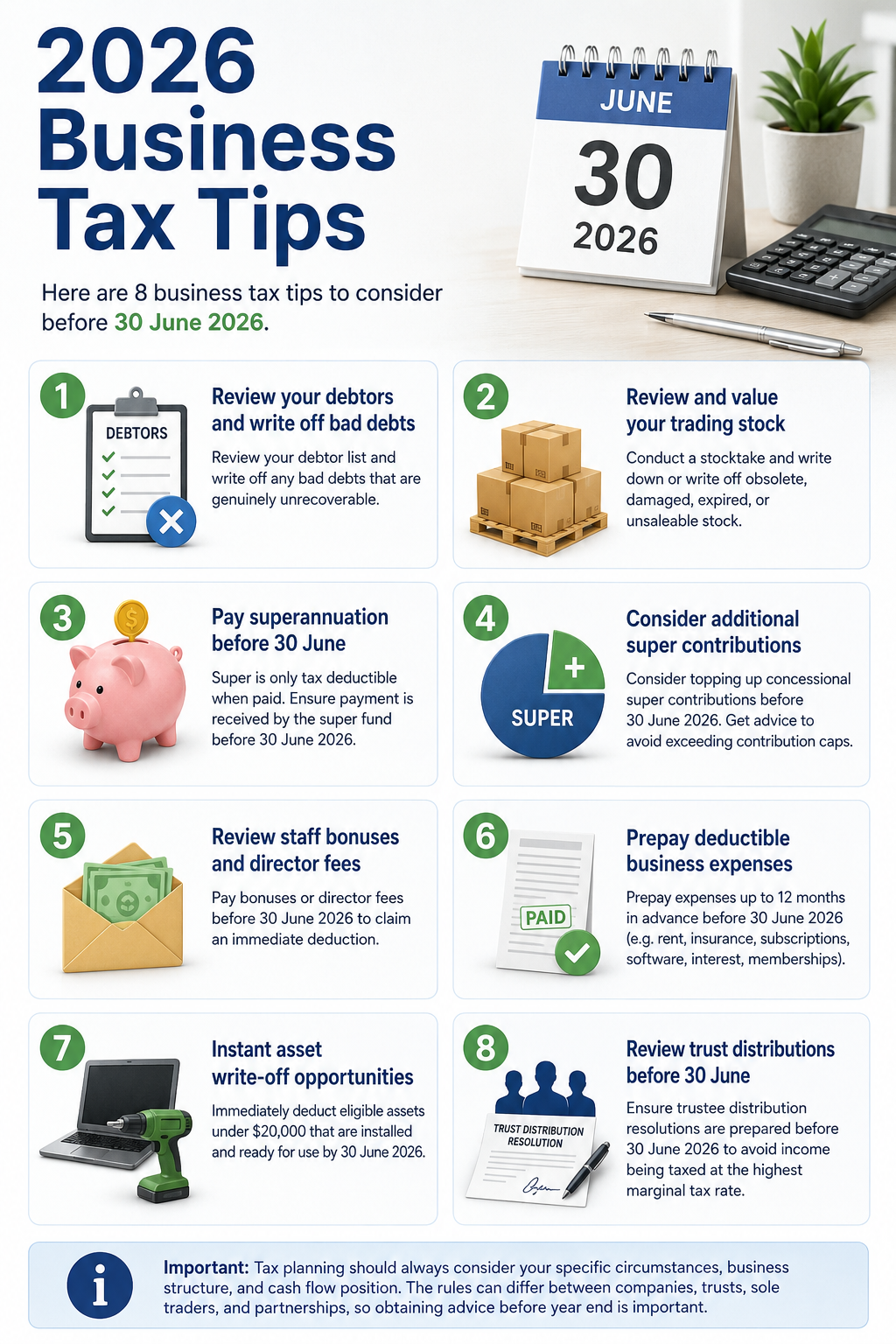
With the end of the 2026 financial year fast approaching, small business owners must prioritize tax planning right now. Once 30 June 2026 passes, it is too late to implement legal strategies to minimize your tax liability.
Maximize your deductions and safeguard your cash flow with these 8 essential business tax tips to consider before year-end.
-
Review Your Debtors and Write Off Bad Debts
Don’t pay tax on income you are unlikely to ever collect. Review your outstanding accounts receivable ledger before 30 June 2026 and formally write off any bad debts that are genuinely unrecoverable.
- Action Step: Ensure the write-off is properly documented in your accounting software before midnight on 30 June. If you happen to recover the debt down the track, you can simply declare it as income in that future financial year.
-
Review and Value Your Trading Stock
If your business holds inventory, you must conduct a physical stocktake to verify your stock on hand before the end of the financial year.
- Action Step: If any items are obsolete, damaged, expired, or entirely unsaleable, formally write them down or write them off before 30 June. Remember, if your current selling price is lower than the original cost, you can generally value that stock at the lower selling price (excluding GST).
-
Pay Employee Superannuation Early
Superannuation is only tax-deductible when it is actually received by the employee’s super fund, not when the clearing house batch is generated.
- Action Step: If you want to claim a deduction for the June quarter superannuation in your 2026 tax return, clear the payments early. Leaving it until the final week of June is highly risky due to bank and clearing house processing times. Aim to pay by mid-June to be safe.
-
Optimize Director Fees and Staff Bonuses
Intending to reward your team or directors for their hard work this year? If you commit to staff bonuses or director fees for work already performed, paying them before 30 June 2026 generally allows the business to claim an immediate tax deduction.
- Action Step: If cash flow is tight and you cannot physically pay before year-end, ensure you properly document and approve a legally binding resolution of the entitlement before 30 June. Depending on your business structure and accounting treatment, this may still secure the deduction.
-
Consider Personal Super Contributions
Business owners and sole traders looking to lower their personal taxable income should consider topping up their concessional superannuation contributions before 30 June 2026.
- Action Step: Review your available caps. You may also be eligible to utilize unused carry-forward concessional contribution amounts from the past five years. Always seek professional advice before making lump-sum contributions to ensure you don’t accidentally breach the cap limits.
-
Prepay Deductible Business Expenses
Small businesses with an aggregated turnover under $50 million can access the “12-month rule” to claim an immediate deduction for prepaid expenses.
- Action Step: Look at expenses covering periods of up to 12 months that extend into the next financial year. Consider prepaying items like rent, commercial insurance premiums, software subscriptions, professional memberships, or loan interest before 30 June 2026 to bring the deduction forward.
-
Leverage the $20,000 Instant Asset Write-Off
For small businesses with an aggregated turnover under $10 million, you can immediately deduct the full cost of eligible business assets costing less than $20,000 per asset.
- Important Update: The Federal Budget announced that this $20,000 threshold will become a permanent fixture of the tax system from 1 July 2026.
- Action Step: While the stability is great news for future planning, for this tax year, the asset must still be physically first used or installed ready for use by 30 June 2026. Eligible assets include tools, computers, office furniture, and work vehicles. Ensure the purchase makes genuine commercial sense rather than being driven purely by tax motives.
-
Finalize Trust Distributions Before 30 June
If your business operates through a discretionary trust structure, you do not have a post-June window to sort out your paperwork. Trustee distribution resolutions must be fully prepared and executed before 30 June 2026.
- Action Step: Failure to properly document trust distributions before midnight on 30 June can result in the trust’s default beneficiaries being taxed, or the trustee being taxed on the undistributed income at the highest marginal tax rate (45%). This is critical if you intend to distribute to corporate beneficiaries or adult children.
Important Disclaimer:
Effective tax planning must always look at your unique business structure, specific circumstances, and cash flow requirements. The rules vary significantly between companies, trusts, partnerships, and sole traders. Always consult with a registered tax agent or accountant before implementing these strategies.
Wayne Wanders is an experienced Business Advisor and Outsourced CFO who can help to scale and grow your business profitably.
Contact Wayne on wayne@arealcfo.com.au or 0412 227 052.
Click on the below buttons to access free Resources developed by Wayne Wanders, A Real CFO to help your business scale and grow profitably
And Wayne is always posting about new grants, funding options and other resources on LinkedIn that can help your business scale and grow profitably. Click on the below links and connect with Wayne or follow A Real CFO on LinkedIn.
Want a confidential discussion on your business situation, help with your grant application or to learn more about my Outsourced CFO Services, simply email me at wayne@aRealCFO.com.au or call me on 0412 227 052
