

Understanding Your Business Numbers: The Key to Profitable Growth
Why most businesses don’t really understand their numbers
Most business owners think they understand their numbers.
They get a profit and loss report.
They scan revenue.
They check the bottom line.
But here’s the problem, most of those reports were built for tax, not for decision-making.
In fact, many P&Ls haven’t meaningfully changed in over 40 years.
They were designed to keep accountants happy, not to help business owners grow.
And that’s why so many people feel busy, stressed, and unsure, even when revenue looks okay.
👉 This post is about changing that.
Why traditional P&Ls don’t help you make decisions
Most businesses have one revenue account.
It’s easy.
It’s tidy.
And it’s almost useless.
I recently worked with a business selling:
- Equipment
- service contracts
- software
- implementation
All recorded as one line of revenue.
They had no idea which part of the business was actually profitable.
Expenses weren’t much better, listed alphabetically, with no connection to what they actually supported.
For example, the business above they had one salaries and wages account. This covered costs of people doing sales, implementation, consulting, service, development and admin
So while the reports looked fine, they offered no insight.
And without insight, decisions become guesswork.
When growth actually makes things worse
Here’s something uncomfortable but common:
Businesses grow…
Revenue increases…
Workload expands…
Yet profit doesn’t move, or even goes backwards.
Why?
Because some products, services, or customers are quietly losing money.
When you can’t see that clearly, growth becomes dangerous instead of exciting.
More effort.
More complexity.
Same or worse results.
But there is a better way.
👉 It starts by changing how you structure your numbers.
The bucket approach
Instead of organising your accounts alphabetically, think in buckets.
Each bucket represents something meaningful:
- a product
- a service
- a channel
- a location
You also have a bucket for overheads.
For the business I mentioned above the buckets would be:
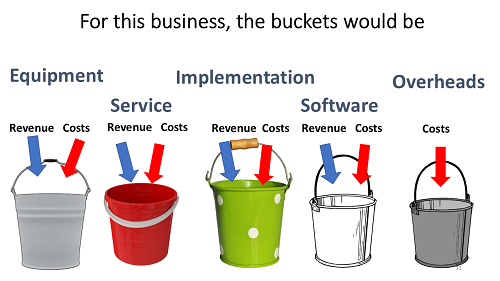
Each bucket becomes its own mini profit and loss.
Now you can clearly see:
✔ what’s working
✔ what’s under pressure
✔ what’s draining profit
This is where clarity starts.
👉 But we can go even deeper, and that’s where the real insight begins.
Adding a turbocharger to your buckets
Once you have buckets, the next step is breaking costs into meaningful activity groups. Every business looks a little different, and that’s exactly how it should be. But here are the typical activity groups I see.
- Customer acquisition
- Cost of delivering your product or service
- Customer retention
- Overheads and admin
- Personal or non-operating costs
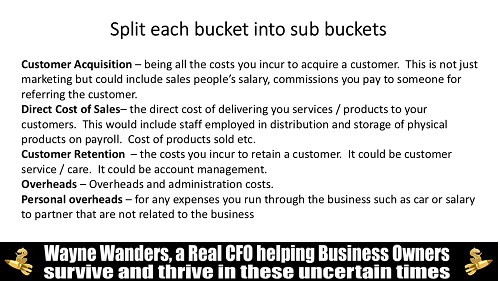
This structure starts revealing patterns you’ve probably never seen before.
👉 Let me show you what this looks like when you apply it to real numbers.
What the numbers really start telling you
On the surface, everything might look fine.
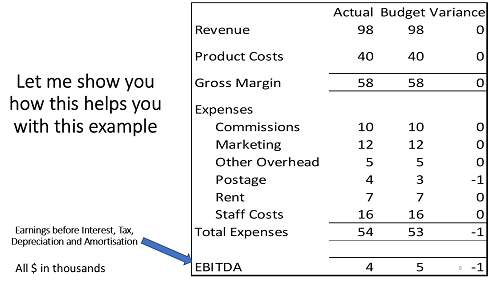
But once costs are properly allocated, you may notice:
- higher discounts than expected
- rising commission costs
- weakening customer contribution
- increasing effort for less return
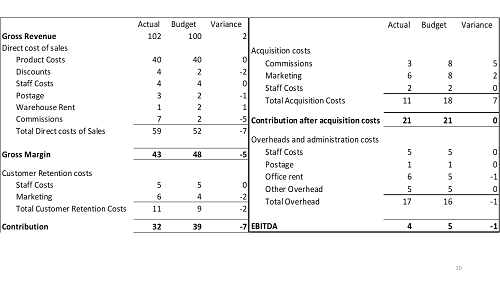
This is the moment when insight replaces assumption.
You stop guessing, and start understanding.
👉 Now let’s talk about the numbers that truly determine whether you grow or go backwards.
The numbers that decide your future
There’s one simple rule:
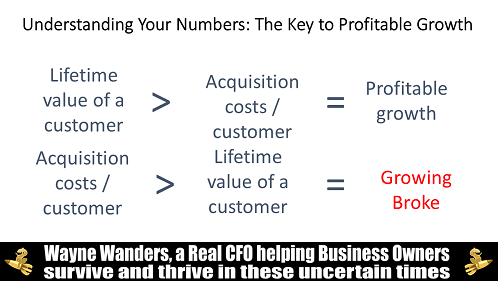
If it costs more to acquire a customer than they’re worth, you’re growing broke.
Two numbers matter most:
- Customer lifetime value
- Cost to acquire a customer
When lifetime value is higher than acquisition cost, growth works.
When it isn’t, growth hurts. You are growing broke.
It really is that simple.
👉 But how do we do this?
Lifetime Value of a Customer
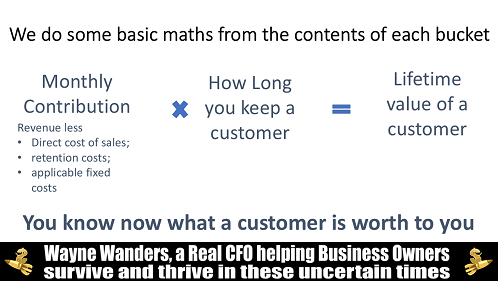
The Lifetime Value (LTV) of a customer is the contribution per customer x how long you keep a customer. Note contribution is revenue less service delivery costs; an appropriate share of retention costs; an appropriate share of applicable fixed costs
Acquisition costs per Customer
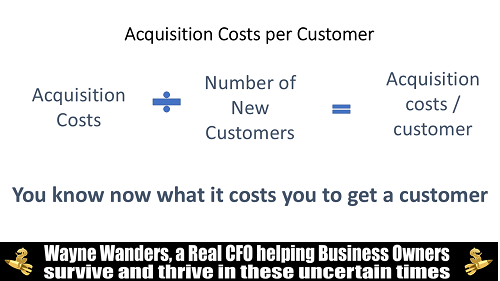
You also need to work out your acquisition costs per customer. This is the total of all your acquisition costs divided by how many new customers you get.
👉 So what do you do with all of this insight?
Let me show you how this helps you with this example
We have a business that sells a prepaid mobile plan for $45 a month. The contribution from this is $5 a month and the average life of that customer is 10 months.
So, the Life Time Value (LTV) is $50.
Now what is you are spending $60 to get this customer?
Without this underlying data, all you are seeing is that your revenue is growing for each customer you get. Which looks good. But your cash is getting lower and lower. You are currently growing broke and you don’t know why and what to do about it.
Once you understand the underlying data, you can now start to take specific action and make decisions such as how to:
- increase monthly contribution above $5 month. For example, upsell, reduce costs
- Increase Life of customer beyond 10 months
- Improve your acquisition strategy to reduce cost to acquire
👉 And that’s how you use buckets and KPI’s to drive improvements at the activity level in your business.
The real takeaway
Over this article, we’ve covered:
✔ why traditional reports fall short
✔ how buckets create clarity
✔ how deeper insight changes decisions
✔ how to grow without breaking your business
And the last point I want to make is that:
No one else gets up each day responsible for your financial future — you do.

But I realise no one has taught you this. And unfortunately, many accountants and bookkeepers don’t understand this either (otherwise they would have set you accounting system up better).
If you want help setting this up or understanding your own data, reach out:
📩 Wayne@aRealCFO.com.au
Or connect with me on LinkedIn
Contact Wayne on wayne@arealcfo.com.au or 0412 227 052.
Click on the below buttons to access other free Resources developed by Wayne Wanders, A Real CFO to help your business scale and grow profitably
Want a confidential discussion on your business situation, help with your grant application or to learn more about my Outsourced CFO Services, simply email me at wayne@aRealCFO.com.au or call me on 0412 227 052
