
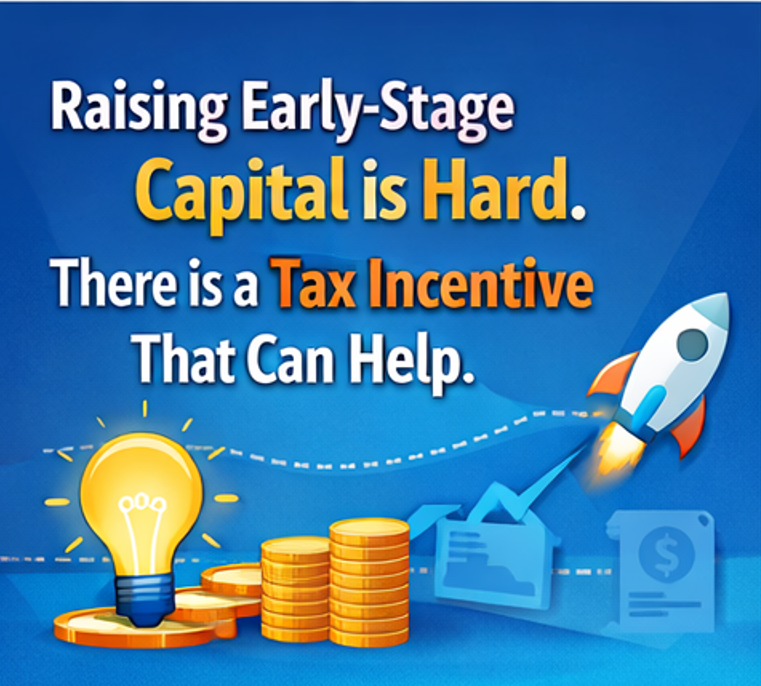
Raising early-stage capital is hard. There is a tax incentive that can help.
For many startups, the biggest growth barrier is not ideas or customers, it is access to early-stage investment.
At this stage:
- Banks usually will not lend
- Revenue may still be limited
- Investors see higher risk and want stronger returns
To help address this, the Australian Government offers a tax incentive called Early Stage Innovation Company (ESIC), designed to reduce the risk for people who invest in startups.
It does not provide funding to your business directly, but it can make investors more willing to invest and faster to commit.
Why ESIC matters for founders
If your startup qualifies as an ESIC, eligible investors may receive:
- A 20% tax offset on the amount they invest, and
- Capital gains tax relief if the business grows and they exit later.
For investors, this improves after-tax returns and softens downside risk.
For founders, that can translate into:
- More interest from angel investors
- Shorter fundraising cycles
- Potentially better valuation and deal terms
In practical terms, ESIC can make your startup more investable.
Is ESIC relevant for your type of business?
ESIC is most relevant for businesses that are:
- In the early stages of commercialisation
- Developing something new or significantly better than existing solutions
- Able to scale without adding costs at the same rate as revenue
- Targeting markets beyond just a local customer base
- Planning to raise equity investment, not just rely on loans or grants
It is less likely to apply to businesses that grow mainly by:
- Adding more staff to deliver services
- Operating as consulting, agency, or contracting models
- Competing only in local or highly fragmented markets
That does not mean these businesses cannot raise capital, but ESIC may not be the right tool for them.
When should founders look at ESIC?
Most startups explore ESIC when they are:
- Preparing for a pre-seed or seed capital raise
- Talking to angel investors
- Entering accelerators or university-linked programs
- Combining private investment with grants or R&D funding
At that point, ESIC becomes part of the broader funding strategy, alongside grants, accelerators, and venture capital.
What next?
If you are planning to raise capital, the next step is to understand whether ESIC is even relevant to your type of business. Not every startup qualifies.
👉 Next: Can your startup qualify as an ESIC? (Eligibility explained)
Contact Wayne on wayne@arealcfo.com.au or 0412 227 052.
Click on the below buttons to access other free Resources developed by Wayne Wanders, A Real CFO to help your business scale and grow profitably
Want a confidential discussion on your business situation, help with your grant application or to learn more about my Outsourced CFO Services, simply email me at wayne@aRealCFO.com.au or call me on 0412 227 052
