
Federal Budget 2026–27: The Small Business & Trust Survival Guide
Most Budget commentary focuses on headlines.
But the real impact on small business is usually buried deep in the Budget papers.
After working through the 2026–27 Federal Budget papers in detail, several themes become clear:
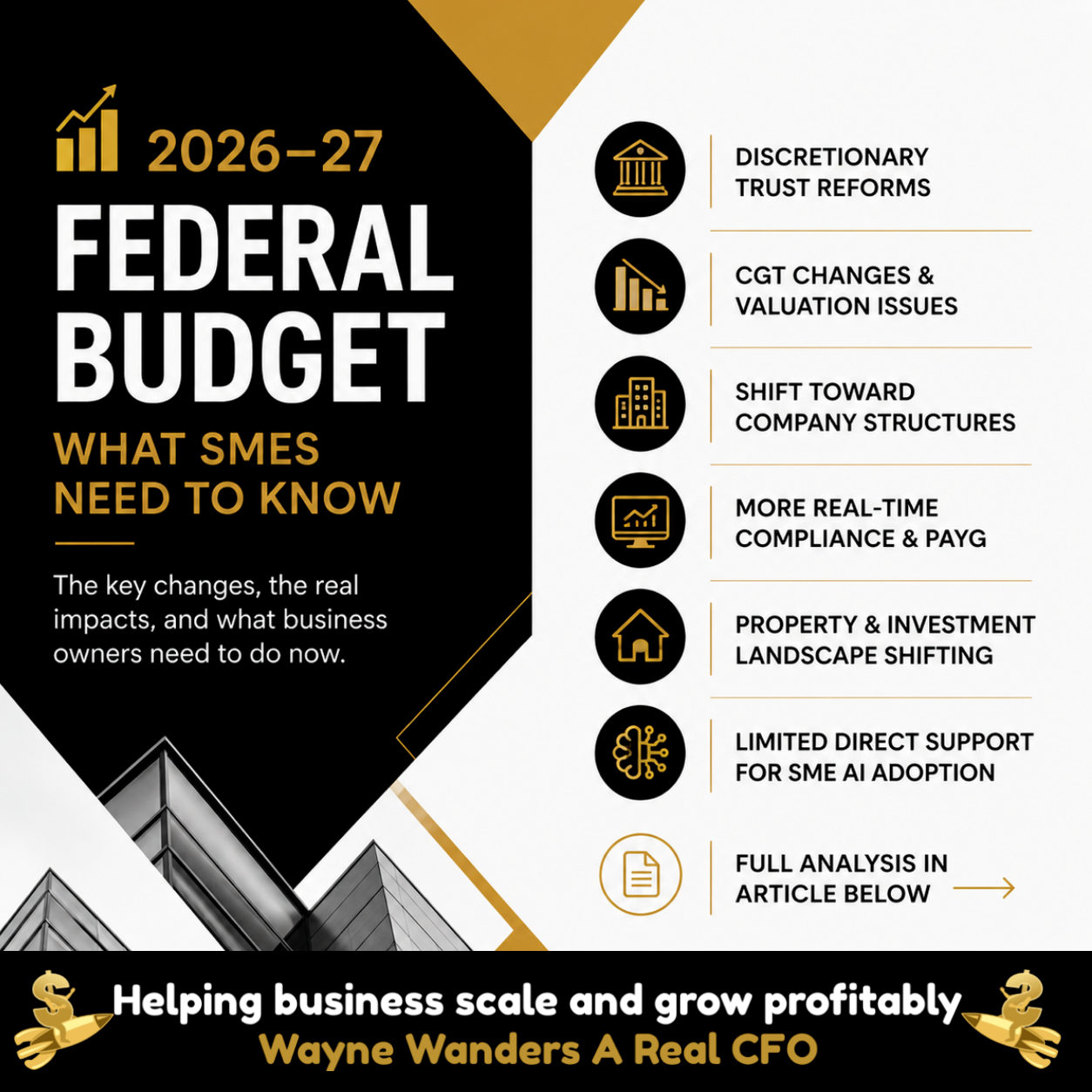
- discretionary trusts are firmly in the Government’s sights
- the tax system is shifting away from passive investment structures
- founders and startup businesses may face unintended consequences
- compliance and real-time reporting obligations are accelerating
- and the Government appears to be pushing SMEs toward more formal corporate structures.
Some of the proposed changes are significant and could materially impact:
- family business groups
- startup founders
- property investors
- professional firms
- and businesses operating through discretionary trusts.
Below is a practical breakdown of the key measures small and medium businesses should be watching closely.
Discretionary Trust Changes
One of the most significant reforms in the Budget is the proposed 30 per cent minimum tax on discretionary trusts from 1 July 2028.
This is arguably one of the largest discretionary trust reforms in decades. The Government’s position is that discretionary trusts facilitate income splitting and provide tax advantages unavailable to ordinary wage earners, marking a clear policy shift toward ‘tax neutrality’ between employees and business owners.
Under the proposal:
- trustees would pay a 30 per cent minimum tax on trust income before it gets to the beneficiary.
- non corporate beneficiaries would receive a non-refundable credit for tax already paid.
- corporate beneficiaries will not get the credit for tax already paid.
The practical consequence is that the traditional tax-planning advantage of distributing income to lower-rate beneficiaries becomes substantially reduced.
For example, based on what is currently proposed, a discretionary trust distributes $50,000 to person. The tax withheld by the trust would be $15,000. A person earning $50,000 would normally pay around $6,500 in tax. They would get the offset against this from the $15,000 from the trust and pay no more tax. But the extra $8,500 tax paid by the trust is not recoverable. And if the distribution was to a corporate beneficiary, the trust would without $15,000 tax and the corporate beneficiary would not get any benefit from this. As you can see, distributions from trusts may result in additional tax being paid (the Government has stated it expects $4.5b in extra tax).
This has potentially major implications for:
- family businesses
- professional firms
- investment structures
- family groups using bucket companies (the corporate beneficiary).
At this stage, the final interaction between:
- bucket companies
- beneficiary distributions
- franking systems
- and trust taxation
will ultimately depend on legislative drafting.
However, based on the Budget papers, the reforms appear likely to materially reduce the effectiveness of many existing discretionary trust strategies.
The Government has recognised the scale of the change by proposing restructuring rollover relief to facilitate movement into:
- companies
- fixed trusts.
This is an important signal. But there is no money to cover the costs you would incur to do this restructuring.
This proposal represents a major philosophical shift away from discretionary trusts as the default SME and family investment structure.
FYI, the minimum tax will not apply to primary production income of farms, certain income relating to vulnerable minors, amounts to which non-resident withholding tax applies and income from assets of testamentary trusts existing at announcement.
Capital Gains Tax Changes
The headline change is the replacement of the broad 50 per cent CGT discount from 1 July 2027. Under the proposed reforms:
- the 50 per cent discount for individuals, trusts and partnerships would be removed.
- inflation indexation of the cost base would return.
- a 30 per cent minimum tax on real capital gains would apply.
Note Superannuation funds are not impacted by this decision. Also excluded are investors who buy new property builds. But currently pre-CGT assets (those purchased before September 1985), will be subject to tax on any gain after 30 June 2027. This is a massive ‘hidden’ change. If you have owned an asset since before 1985, its ‘tax-free’ status effectively ends on 30 June 2027. Any growth after that date is taxable.
Valuation issues for all Business Owners
If you sell an asset like your business after 30 June 2027, there is a two-step process to determine the taxable capital gain.
Step 1 – calculate the gain from when you acquired the asset, to what the asset is worth on 30 June 2027. That gain will be subject to the 50% discount. For example, cost base is $100,000 and value at 30 June 2027 was $500,000. The gain is $400,000 and with the 50% discount the taxable gain would be $200,000.
Step 2 – Then for the growth in asset value after 30 June 2027, the taxable gain will be determined based on the selling price, less the indexed value of the business as at 30 June 2027. Using the same example above, let’s say the asset sold for $750,000 and the indexed cost base (using the $500,000 value as at 30 June 2027) is $600,000, the taxable gain is $150,000.
This brings the total taxable capital gain to $350,000.
Presented this way, it appears very simple from a maths perspective. But to ensure you get the maximum benefit, you will need to determine the value of the asset such as your business, as at 1 July 2027.
The budget papers state an asset’s value at 1 July 2027 will be determined by taxpayers as part of their tax return in the year the asset is realised. You can either:
- seek a valuation of the asset as at 1 July 2027, which will include using quoted prices for assets such as shares; or
- use a specified apportionment formula that estimates the asset’s value on 1 July 2027, based on its growth rate over the asset’s holding period. The ATO will provide tools to estimate this value for taxpayers.
The smartest option would be for business owner to know both numbers. The pre 1 July 2027 gain using market value and the gain using the apportionment formula. The problem is that if you want to do this, then every business owner / founder / investor will effectively need to value their business (and any other capital assets that they own) as at 30 June 2027 / 1 July 2027.
I am not sure what “proof” the ATO will want around these valuations and whether they will want formal independent valuations for your business. This could be an expensive and time-consuming exercise for all business owners.
Cost Base Issues for many Business Owners
One area that appears poorly accommodated by the reforms is startup founder and new business equity. Startup founders and new business owners often:
- take minimal salaries for years
- contribute unpaid labour and risk
- hold equity with very low-cost bases. For example, they could have put $100 in as share capital.
Under the proposed indexed system, many founders may still face large taxable gains despite years of under-compensated work and significant commercial risk.
If the business is in existence today, they can get some relief by valuing their business as at 30 June 2027. But for founders and new business owners who create new businesses after 30 June 2027, they may suffer from the low dollar indexation of their cost base. $100 share capital indexed even by 50% is still only $150. As a result, all bar $50 of what could be a large sale proceeds, would be subject to tax.
This seems unfair. But it looks like the Treasurer has heard this and has committed also consult with stakeholders on key details, including the treatment of early‑stage and start‑up businesses given the unique features of the tech and start‑up sector.
R&D Tax incentive
The Budget significantly expands the R&D Tax Incentive framework while simultaneously increasing integrity and compliance activity.
Some proposed changes to the R&D Tax incentive that impact small business and startups include:
- turnover threshold for the refundable offset increased to $50.0 million (was $20m).
- offset for businesses under $50m in turnover increases from 18.5% to 23%.
- Businesses over 10 years old will no longer receive a refundable tax offset
- increasing the minimum expenditure threshold to $50,000 (was $20,000).
- expenditure on supporting activities, will no longer be eligible. This will have an adverse impact on many claims. Business will need to be mindful of how they categorize activity and expenses.
- the ATO has been given more money to look at compliance and fraud in the R&D Tax incentive space.
Loss Carry Backs
One of the measures the Federal Government announced to help businesses is the permanent introduction of the Loss Carry Back. This will apply to all businesses with a turnover up to $1 billion and start from the 2027 tax year.
If you have incurred a tax loss in any tax year from the 2027 tax year onwards, and you have paid tax in the previous 2 tax years, you may receive a cash refund of tax paid in these previous 2 years, or a reduction in the debt you owe the Australian Taxation Office. Obviously, this is up to the higher of the after-tax value of the tax loss or the tax paid in those 2 years.
For example, you pay $100,000 tax in the 2026 tax year but have a tax loss of $50,000 in the 2027 year. You will be eligible for a refund of $12,500 (being 25% of $50,000). If the tax loss in the 2027 year was $500,000, the most you would be refunded is the $100,000 in tax you paid.
Loss refundability to help start-ups
From 1 July 2028, start‑up companies with aggregated annual turnover of less than $10m that generate a tax loss in their first two years of operation will be able to utilise the loss to generate a refundable tax offset.
The offset will be limited to the value of fringe benefits tax and withholding tax on wages paid in respect of Australian employees in the loss year.
Instant asset Write off to stay at $20,000 for Small Business
The $20,000 instant asset write off will now be made permanent for small business (turnover less than $10m). This applies to sole traders, partnerships, trusts, or companies.
So, a plus for small business in that you don’t need to rush out and buy all those assets in June 2026 to get the deduction this year. But if you are already planning to buy some equipment, you might as well do it before 30 June, as you get the deduction earlier.
Expanding venture capital incentives
Venture capital investors can operate through venture capital limited partnerships (VCLPs) and early-stage venture capital limited partnerships (ESVCLPs), which provide a ‘flow through’ structure and targeted tax incentives to the investors such as tax offsets.
But these vehicles have caps on deal size. The Budget proposes to increase the caps on these deal sizes. Whilst this helps those businesses who fit the investment profile typically targeted by VC funds, this is no help to the many other great businesses out there who VC’s don’t fund.
Small Business Responsible Lending Obligation Exemption Extension
The Small Business Responsible Lending Obligation (RLO) exemption allows lenders to bypass strict “responsible lending” checks for loans intended for small business purposes, simplifying access to credit for small businesses. This was due to expire on 3 October 2026 but is extended by a further 10 years.
Expansion of the ATO’s dynamic PAYG instalment pilot
This dynamic PAYG instalment pilot allows businesses to vary their PAYG instalments, without risk of interest changes, based on more up-to-date business conditions by using an ATO-approved dynamic instalment calculation embedded in your business accounting software. Also, business can opt in to pay their PAYG monthly from 1 July 2027.
It remains unclear whether this will improve SME cash flow outcomes as the budget papers say this increases tax collections.
AI and Productivity
You would expect with the current poor rates of productivity growth in Australia, there would be some effort towards using AI to improve productivity. But AI barely gets mentioned in the main Budget Papers
There appears to be no money for small businesses to adopt AI to improve their business processes. All I can see is $70m for the AI Accelerator CRC program rounds (see below for more on this), and more use of AI by government departments to make them more efficient.
To me this appears to be one of the weaker areas in the budget. A lot of motherhood statements in this “Productivity Package” and I am not sure we will see any meaningful improvement in productivity if we rely on the Federal Government.
Continued or Stopped Funding for small business programs
The Federal Government will continue to fund the NewAccess for Small Business Owners Program and the Small Business Debt Helpline.
As part of the budget repair process the Federal Government has now closed the Australia’s Economic Accelerator (AEA) Ignite and Innovate Programs saving $800m+. For those who don’t know this program was designed to connect university research with business to commercialise this research. Large adverse hit to the ability to commercialise university research.
But on the other side the Government is continuing to fund the Cooperative Research Centres (CRC) and CRC-P programs. This includes $70m available through upcoming rounds of the starting in 2026 and 2027 for an ‘AI Accelerator’ to accelerate the development and commercialisation of AI by Australian researchers and businesses. Business should be on the look for this and work out how they can partner with a university to access this funding.
There is mention in the budget papers for more funding for the CSIRO, but I am hearing of some programs closing. So not sure where this funding is going.
On top of this, there are further savings of $266.2 million over five years from 2025–26 by redirecting uncommitted grant funding in the Industry, Science and Resources portfolio. There is no mention of what specific grant programs, but I expect part of this is the reduced funding for the Industry Growth Program.
Will wait and see what other grant program cuts were buried in the budget.
Final Thoughts
This Budget is far more structurally significant than many of the media headlines suggest.
While there are some genuinely positive measures for SMEs, including the permanent instant asset write-off, expanded loss carry-back rules and startup support measures, the broader direction is clear:
- more compliance
- more transparency
- more real-time reporting
- and reduced reliance on traditional tax-planning structures.
For many businesses, particularly those operating through discretionary trusts or holding appreciating assets, the next few years may involve significant restructuring and planning decisions.
The detail of many of these measures will ultimately depend on legislation and consultation, so this remains an evolving space.
If you are a founder, business owner, or growing SME, this is the sort of environment where having strong strategic financial advice matters more than ever.
At aRealCFO, we help businesses navigate:
- growth and scaling
- cash flow and profitability
- funding and capital raising
- business structuring
- commercial strategy
If you would like to discuss how these proposed Budget changes may impact your business or structure, feel free to reach out.
Wayne Wanders is an experienced Business Advisor and Outsourced CFO who can help to scale and grow your business profitably. Wayne may also be able to assist you in preparing any grant application.
Contact Wayne on wayne@arealcfo.com.au or 0412 227 052.
Click on the below buttons to access free Resources developed by Wayne Wanders, A Real CFO to help your business scale and grow profitably
And Wayne is always posting about new grants, funding options and other resources on LinkedIn that can help your business scale and grow profitably. Click on the below links and connect with Wayne or follow A Real CFO on LinkedIn.
Want a confidential discussion on your business situation, help with your grant application or to learn more about my Outsourced CFO Services, simply email me at wayne@aRealCFO.com.au or call me on 0412 227 052
