

Essential Business Funding Insights: Key Takeaways from Top VCs and CFOs
I’ve spent some time over the past couple of days listening to various experts talk about funding for business growth.
Here are the core takeaways from those sessions..
Customer Revenue: The Ultimate Funding Source
The best way to fund your business is still from customers. Not only is this cash, but more importantly, it is validation.
General funding principles
- Fund Allocation: Carefully evaluate the quantum of the funding you need and plan exactly how you will deploy it.
- Unit Economics: Thoroughly understand your numbers and key metrics. Pay close attention to the efficiency of deployed capital and your exact payback period.
- Pathway to Profitability: If you are not currently profitable, define a clear path to get there. Always build in a time buffer for unexpected delays. Investors want to see assuredness around your operational plan without overconfidence.
- Reverse Engineer Milestones: Calculate your raise to ensure it gives you enough runway to hit a concrete proof point to underpin future funding rounds.
- Continuous Preparedness: Always be ready to raise capital or execute an exit strategy. Opportunities appear unexpectedly; if you aren’t prepared when an investor reaches out, it creates a poor impression regarding your operational discipline.
What funders are looking for
When meeting with potential funders, clearly articulate why your business will win in the market:
- The Narrative: Explain “Why you?”, “Why this opportunity?”, and “Why now?”
- Competitive Advantage & Moat: Define what gives you a defensible moat against both direct and tangential competitors (remember, every business has competition).
- Data & Speed as a Moat: A primary moat for modern businesses is controlled proprietary data and the speed at which you translate that data into strategic action.
- Founder Role: As a founder or CEO, your core responsibility is acting as the Chief Inspiration Officer to minimize talent turnover, a vital component of your operational moat.
- AI Strategy: Investors view AI as both an opportunity and a threat. If you do not explicitly show how AI serves as a tailwind for your business, investors will assume it is an unaddressed headwind.
- Technical Due Diligence: Expect investors to conduct rigorous technical due diligence, often utilizing AI tools to evaluate your software architecture and tech stack.
Navigating the Fundraising Process
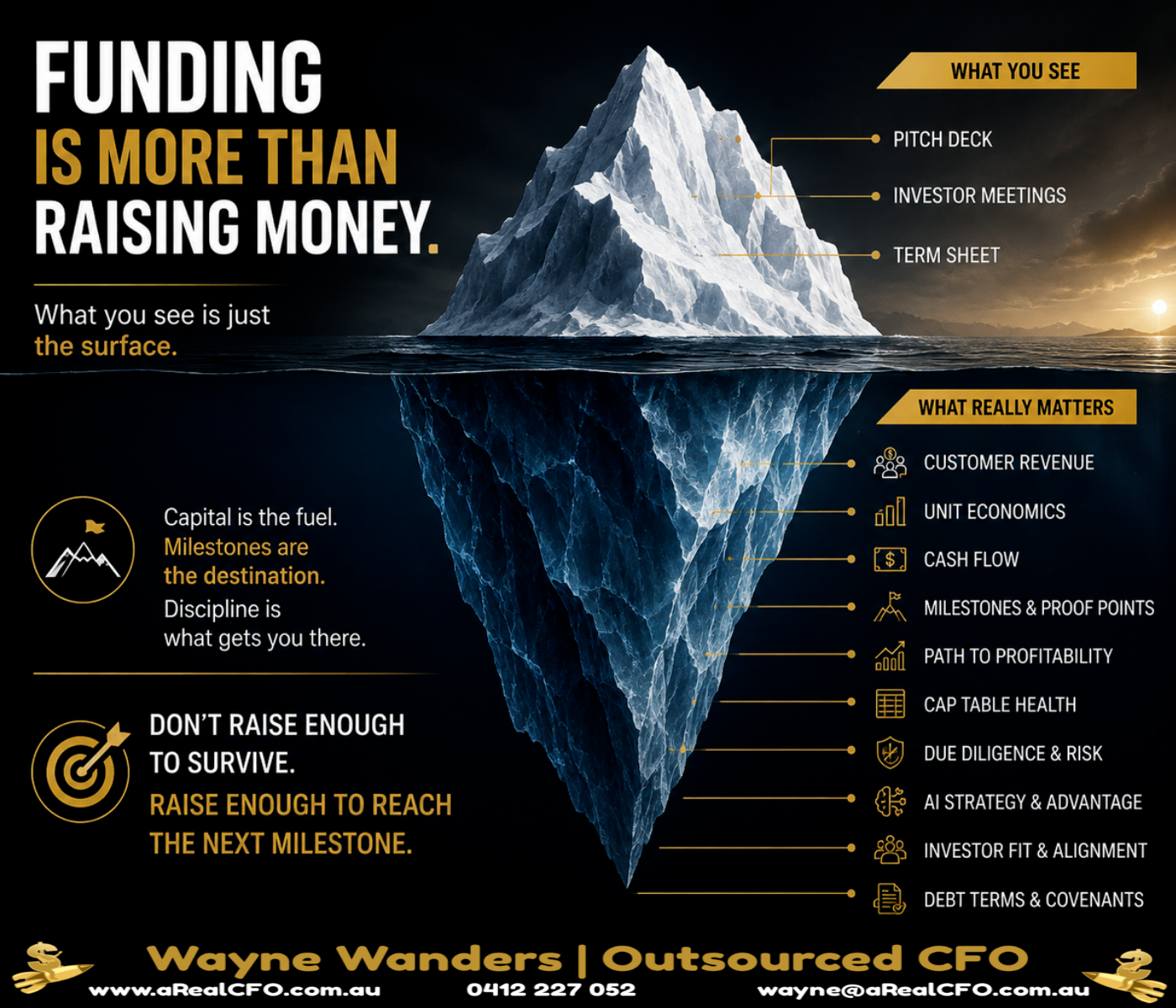
- Resource Allocation: Capital raising is an iceberg. The pitch deck and initial meetings are just the surface. Fundraising can absorb up to 60% of leadership’s time, so avoid involving too many core team members early on to protect daily operations.
- Portfolio Risk Management: Capital providers must manage portfolio concentration risk. Rejections may stem from an investor’s internal portfolio balance rather than flaws in your business model.
- Strategic Alignment: Partner exclusively with investors you can work with long-term; an investment agreement is only as strong as your first major disagreement.
Cap Table Management
- Cap Table Modeling: Model your capitalization table prior to every round, paying close attention to preference stacks.
- Maintain a Clean Cap Table: Messy cap tables deter prospective investors. Address issues like inactive ex-founders, former staff, or non-contributing advisors still holding equity (which may require a “cram down”). Minimize complex terms like varied preference rights and valuation caps.
VC Growth Expectations
- For a long time, I worked on VC’s wanting what I call the double triple, tripe double growth rate. 2 years of triple growth and 3 years of double growth.
Let’s say your revenue is $1m. The double triple, triple double needed your revenue projections to be:
$1m to $3m to $9m to $18m to $36m to $72m. A growth rate over 5 years of 720%.
- Now many US VCs are talking about 3 times 10x. This is $1m to $10m to $100m to $1,000m. A growth rate of 1,000% over 3 years. A much higher bar to attract US VC investment.
Debt funding Considerations
- Predictability: Debt funding relies heavily on revenue and cash flow predictability. Lenders require consistent cash flows to cover serviceability before extending debt facilities.
- True Cost of Capital: Model the complete cost of debt, factoring in origination fees, minimum interest commitments, and warrants. A low headline rate does not always equal the cheapest facility.
- Control Covenants: Review all debt control terms, financial covenants, and restrictions carefully before signing.
Special thanks to the following industry experts whose insights contributed to these takeaways:
Steve Allan, Founder Blue Corridor Ventures
Rob Paterson, CFO at Employment Hero
James Johnstone, Partner at Bailador Technology Investments
Kal Jamshidi, Managing Director at Mighty Partners
Wayne Wanders is an experienced Business Advisor and Outsourced CFO who can help to scale and grow your business profitably.
Contact Wayne on wayne@arealcfo.com.au or 0412 227 052.
Click on the below buttons to access free Resources developed by Wayne Wanders, A Real CFO to help your business scale and grow profitably
And Wayne is always posting about new grants, funding options and other resources on LinkedIn that can help your business scale and grow profitably. Click on the below links and connect with Wayne or follow A Real CFO on LinkedIn.
Want a confidential discussion on your business situation, help with your grant application or to learn more about my Outsourced CFO Services, simply email me at wayne@aRealCFO.com.au or call me on 0412 227 052
