

Financial Forecasting for Small Business: Why Revenue Growth Kills Cash
December 8 is officially Pretend to Be a Time Traveller Day.
December 8 is officially Pretend to Be a Time Traveller Day.
So let’s play along. Imagine you could jump into a time machine today and travel 12 months into the future of your business.
You land in December 2027, pull up your accounts, and see fantastic news: Revenue has grown by 30%.
But as you look closer at the operational reality, a very different picture emerges:
- Cash flow is tighter than ever before.
- Profit margins have fallen, despite higher volume.
- You’ve hired more people, but you’re working longer hours to keep up.
- And somehow, despite all that growth, you’re making less money.
Not quite the future you had planned!
This happens when expanding your sales takes more money out of your bank account than it puts back in. Without looking ahead, fast growth often drains your cash reserves, pushes up your overheads, and leaves you with smaller profits.
The 3 Buttons on Your Business Time Machine
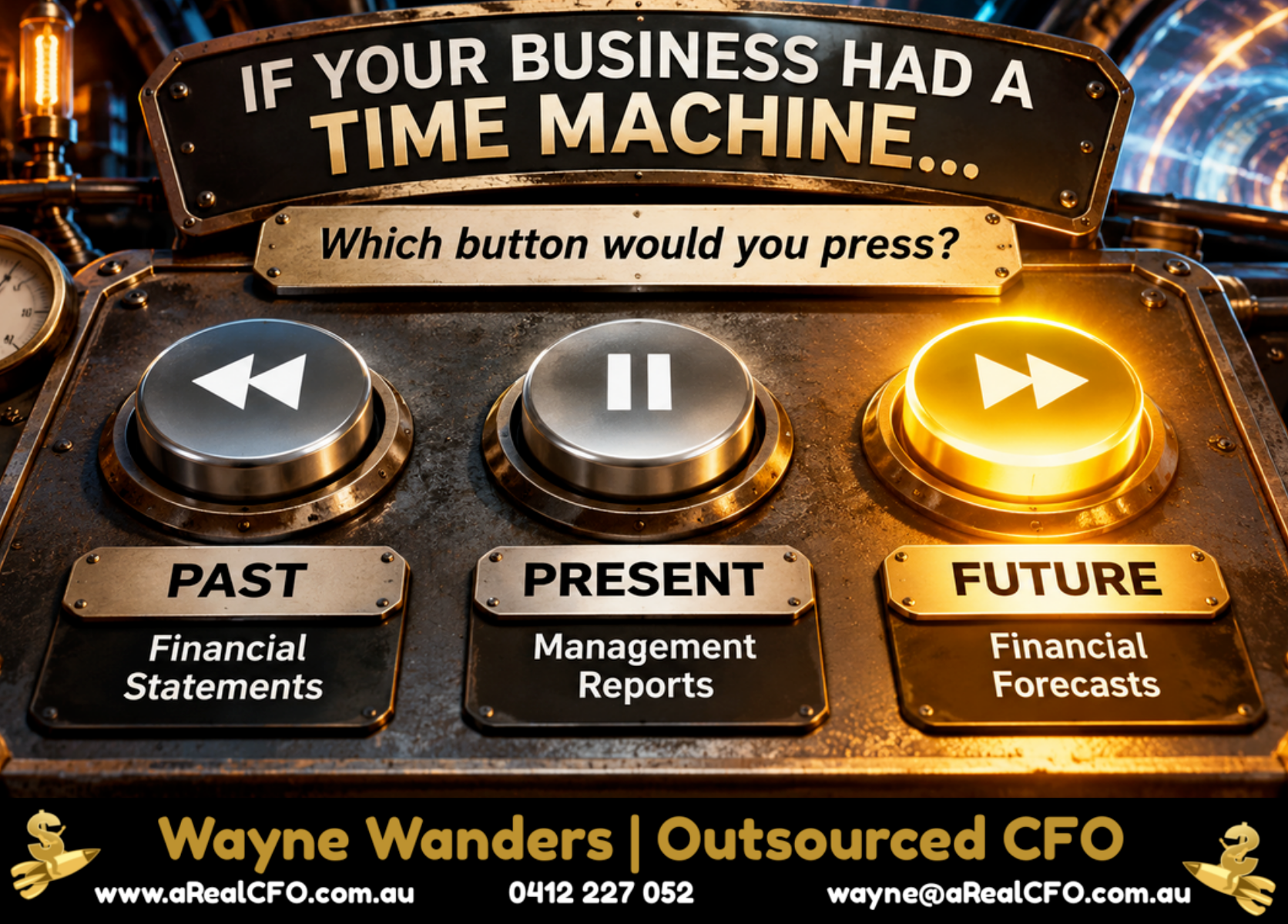
Now imagine your financial time machine has three distinct settings:
- ⏪ PAST (Historical Financial Statements): Your tax reports and balance sheets tell you what already happened. It’s useful historical information, but you can’t change it.
- ⏸️ PRESENT (Management Reports): Real-time reports tell you what’s happening right now. At least you can see where problems and cash leaks are developing today.
- ⏩ FUTURE (Financial Forecasts): Forward-looking plans help you understand what might happen next—and more importantly, what decisions you can make differently today to shape that outcome.
Most business owners spend a lot of time looking backwards, some time understanding the present, and nowhere near enough time modeling the financial consequences of their future decisions.
Testing Decisions Before You Commit Cash
You don’t need a DeLorean to explore your business’s future. You need a financial forecast that lets you test different decisions before committing real money.
Before making your next big operational move, a proper forecast helps you answer critical real-world questions such as:
- “Can I actually afford this new hire?”
- The Trap: Assuming a $90k salary just means finding $90k in revenue.
- The Reality: Between superannuation, equipment, software licenses, and onboarding downtime, that employee might cost $115k, and take 4 months to reach full productivity. A forecast models the exact cash buffer you need until they pay for themselves.
- “Will more sales leave me with more cash, or less?”
- The Trap: Equating higher sales volume with a healthier bank balance.
- The Reality: Fast growth drains cash quickly. If you pay suppliers or wages upfront, but clients don’t pay their invoices for 60 days, rapid growth will hollow out your cash reserves before the revenue actually lands.
- “Are my prices actually making me money today?”
- The Trap: Relying on pricing structures set 12 or 18 months ago.
- The Reality: As supplier costs and wage pressures creep up, your gross margin erodes silently. Selling 20% more volume at a diluted margin means significantly more work for less net profit.
- “Can my cash flow handle a sudden bump in the road?”
- The Trap: Planning strictly for your best-case revenue scenario.
- The Reality: What happens if your top client delays payment by 30 days, or a major project gets pushed back a quarter? Scenario forecasting stress-tests your business against unexpected slowdowns so you can build a safety buffer in advance.
How Financial Forecasting Protects Your Future
That is a big part of what I do as an Outsourced CFO. I help business owners look beyond last month’s numbers and make better decisions about what comes next.
Working with an Outsourced CFO shifts your focus from reactive record-keeping to proactive decision-making:
- Identify cash flow bottlenecks months before they hit your bank account.
- Protect your profit margins as your business scales.
- Plan growth trajectories grounded in cash flow realities rather than top-line revenue targets alone.
Prepare Your Business for What Comes Next
While we can’t predict the future, we can certainly prepare for it.
If you could travel 12 months into your business’s future, what’s the one thing you’d want to know today?
📌Frequently Asked Questions:
Q: Why does revenue growth sometimes cause cash flow problems?
A. Revenue growth requires upfront spending on inventory, new hires, equipment, and operating expenses. If your clients pay on 30- to 60-day terms, but your suppliers and staff must be paid immediately, fast growth drains your bank balance before the revenue actually clears. This gap between making a sale and receiving the cash is why growing businesses often experience severe cash squeezes.
Q: What is the difference between an accountant and an Outsourced CFO?
A: Your traditional accountant focuses primarily on the past—tax compliance, historical balance sheets, and end-of-year reporting. An Outsourced CFO focuses on the future, providing forward-looking financial forecasts, scenario planning, pricing strategies, and cash flow management to help you make proactive business decisions.
Q: Isn't financial forecasting just guessing the future?
A: Financial forecasting is not about predicting market conditions with a crystal ball. It is about scenario modeling. A solid forecast tests “what if” situations—such as hiring a new team member, raising prices, or facing a 30-day payment delay—using your actual historical data and realistic cost assumptions so you can make informed decisions before risking real cash.
.
Q: How far into the future should a small business forecast?
A: For day-to-day survival and growth, a 13-week rolling cash flow forecast gives you immediate visibility over operational expenses and short-term cash bottlenecks. For strategic moves—like expanding operations, raising prices, or adding headcount—a 12-month financial model helps you align your cash flow with long-term profit goals.
.
Q: When should a business owner start using financial forecasting?
A: You should implement financial forecasting as soon as your business decisions carry financial risk. If you are considering bringing on staff, making major capital purchases, expanding services, or if revenue is growing but cash reserves feel uncomfortably tight, a forward-looking forecast is essential.
.
Wayne Wanders is an experienced Business Advisor and Outsourced CFO who can help to scale and grow your business profitably.
Contact Wayne on wayne@arealcfo.com.au or 0412 227 052.
Click on the below buttons to access free Resources developed by Wayne Wanders, A Real CFO to help your business scale and grow profitably
And Wayne is always posting about new grants, funding options and other resources on LinkedIn that can help your business scale and grow profitably. Click on the below links and connect with Wayne or follow A Real CFO on LinkedIn.
Want a confidential discussion on your business situation, help with your grant application or to learn more about my Outsourced CFO Services, simply email me at wayne@aRealCFO.com.au or call me on 0412 227 052
