
Why Business Structures Are About Asset Protection, Not Just Tax
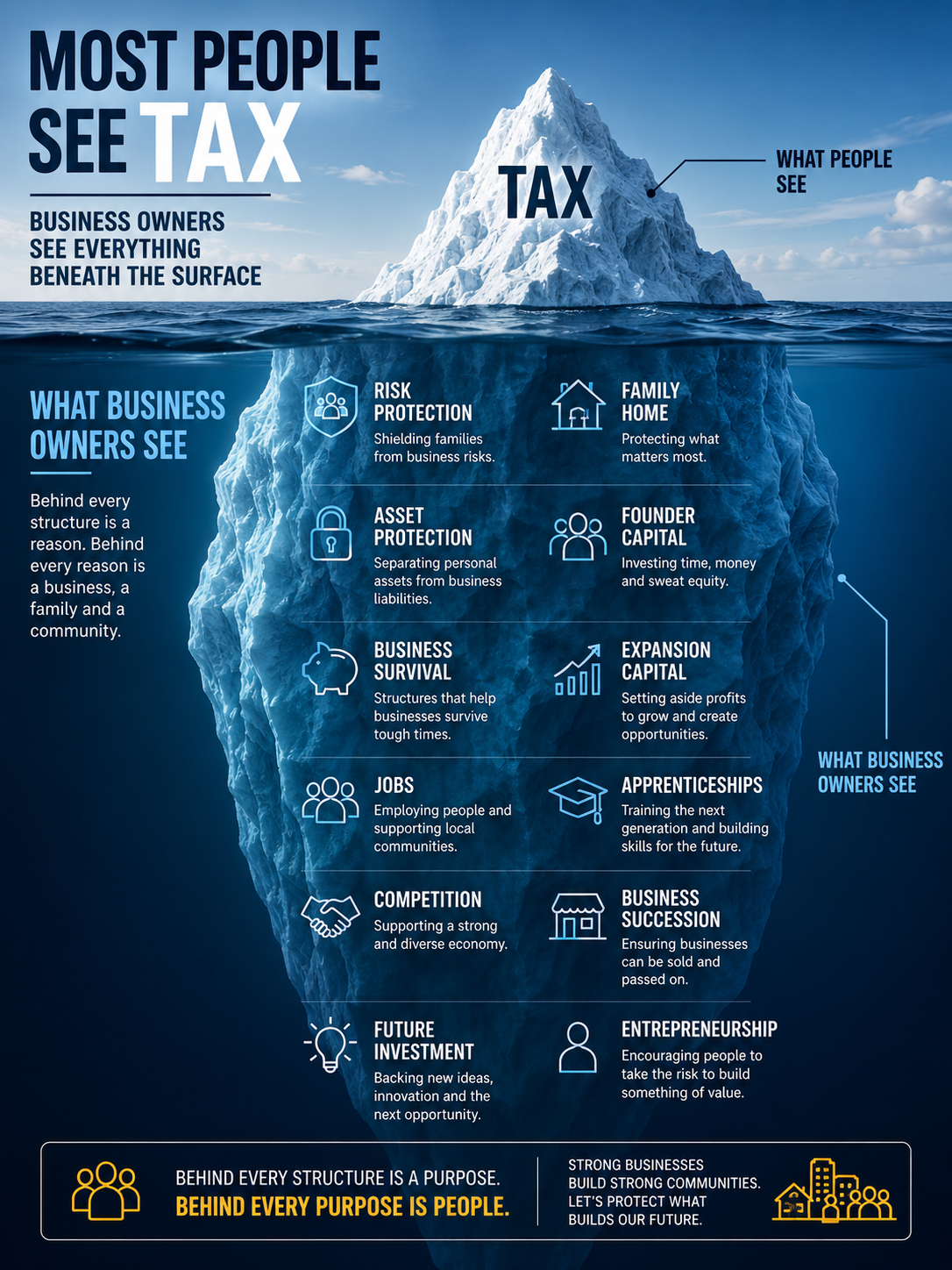
When people hear discussions about discretionary trusts, proprietary limited companies, shareholder loans, and “bucket companies”, it is easy to assume these corporate structures exist simply to reduce tax.
But that assumption misses the operational reality of running a small business in Australia.
The reality is that choosing the right business structure is primarily a matter of risk management and long-term asset protection. The businesses navigating these complex legal frameworks are the very backbone of suburban and regional Australia, employing local workers, training apprentices, and keeping our communities moving.
They:
- sponsor the local footy club.
- train apprentices.
- support local suppliers.
- build homes, repair vehicles, service air conditioners, run medical clinics and keep local economies moving.
- are the fabric of suburban and regional Australia.
The:
- electrician with 12 employees.
- mechanic with three apprentices.
- civil contractor who spent 20 years reinvesting profits and now employs 40 people.
- family business that has survived recessions, the pandemic and changing markets.
When public debate focuses solely on changing how business owners are taxed, it ignores the ripple effect on investing, expanding, and hiring. More often than not, a business structure is established not as a tax loophole, but as a vital shield against commercial risk.
The decisions business owners make about investing, expanding, employing staff and eventually selling their businesses can have consequences that flow through entire communities.
What many people don’t realise is that the structures often being criticised today were not necessarily created for tax reasons.
More often than not, they were created to manage risk.
The following real-world examples and observations help explain why.
Part 1: How Discretionary Trusts and Companies Protect Personal Assets
When someone comes to me asking about the best structure for a new business, my first question is not about tax.
It’s about risk.
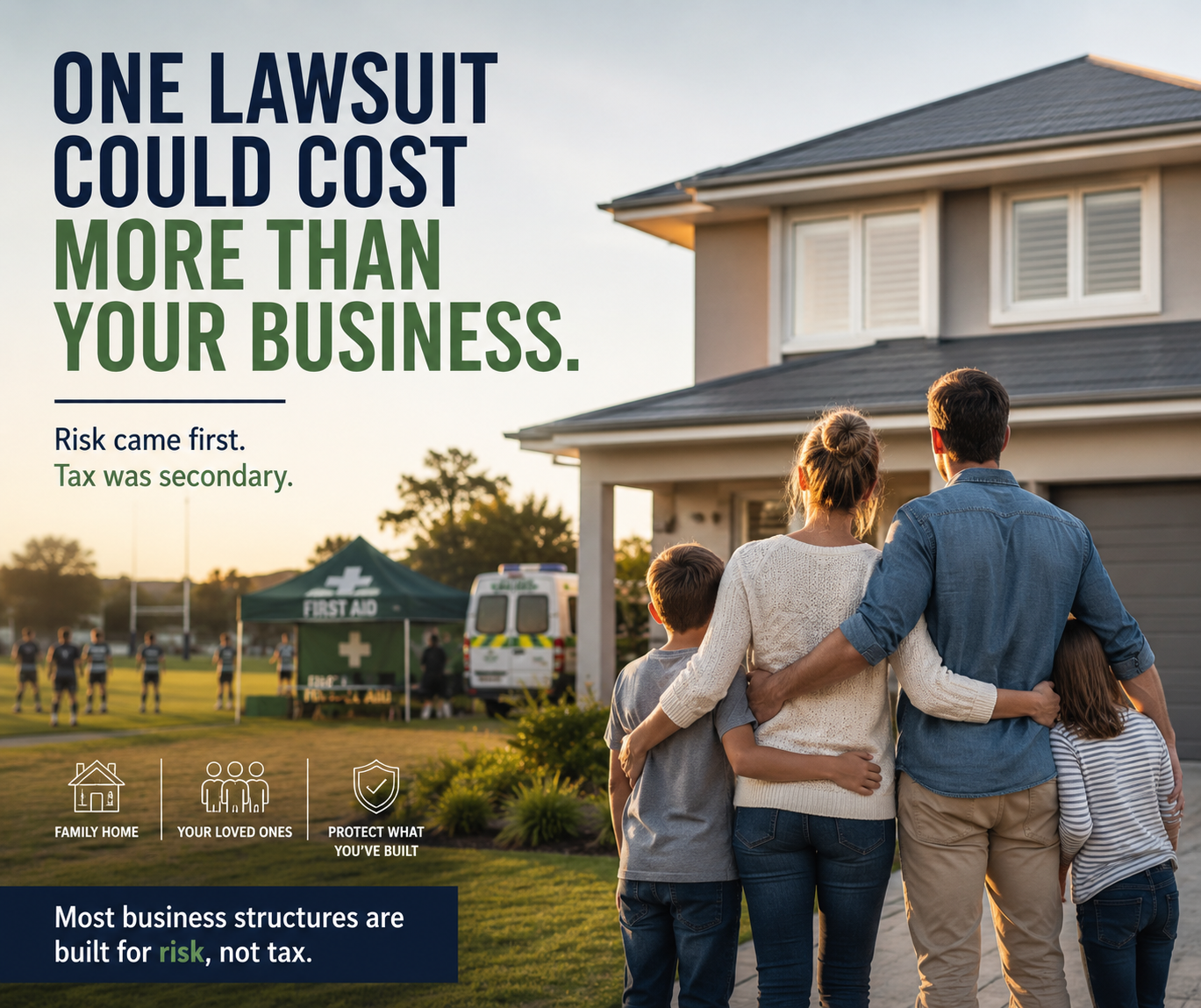
Years ago, I spoke with a paramedic who operated a business providing first aid services at school sporting events and rugby carnivals. He was operating as a sole trader.
I asked him a simple question.
What would happen if someone died at an event where you were providing medical services and the family sued you?
This wasn’t a hypothetical question. A school student had died at one of my children’s sporting events not long before this conversation.
If the damages exceeded your insurance cover, or the insurer refused the claim, the liability could fall directly on you personally.
This paramedic owned a home with his partner.
A successful claim could have forced the sale of that home.
Imagine having to explain to your partner that the family home was lost because of a business activity they had no involvement in.
That is why structure matters.
A company creates a fence between the business and the owner’s personal assets.
But sometimes the gate in that fence can still be opened.
A trust owning the company adds a lock to the gate by separating ownership from the trading activities of the business.
These structures are often established because of risk management, not tax planning.
Part 2: Director Loans vs Share Capital: Managing Small Business Risk
The same principle applies when founders put money into their businesses.
Most companies start with only a small amount of share capital.
That is not because someone is trying to create a tax advantage.
It is because startups and small businesses are risky.
Once the company is established, founders generally have two ways to provide additional funding:
- Invest more share capital.
- Lend money to the business under a formal loan agreement.
Many founders choose the second option.
Again, the reason is risk.
I have seen businesses where investors promised future funding rounds and then failed to deliver.
The business entered administration.
The founder lost control of their company and watched years of hard work, intellectual property and business assets sold for cents in the dollar (sometimes to competitors).
A secured founder loan can change that outcome.
A founder who is a secured creditor often has significantly more influence over what happens during an administration process and may be able to recover key assets or restart the business.
There is also a practical benefit.
Money lent to a company can generally be repaid more easily than money invested as share capital, which often requires formal capital reduction processes and additional compliance.
Part 3: What is a Bucket Company? Using Corporate Beneficiaries for Risk Management
The same principle applies when a successful business starts generating profits.
I have a client who has spent 15 years building their business.
Business conditions today are very different to when they started. AI in particular may result in significantly diminished returns in the years ahead. Combined with some fatigue from operating in the same industry for so long, they are now exploring other opportunities.
To pursue those opportunities, they need capital that their existing business has built up over many years and already paid company tax on.
Many people assume the obvious answer is to simply leave the profits in the trading company until they are needed. But that creates a problem.
The trading company is where the risk lives.
- It deals with customers.
- It signs contracts.
- It employs staff.
- It can be sued.
- It can face disputes.
- It can fail.
If significant cash reserves are left sitting inside that trading company, those funds are exposed to the same risks.
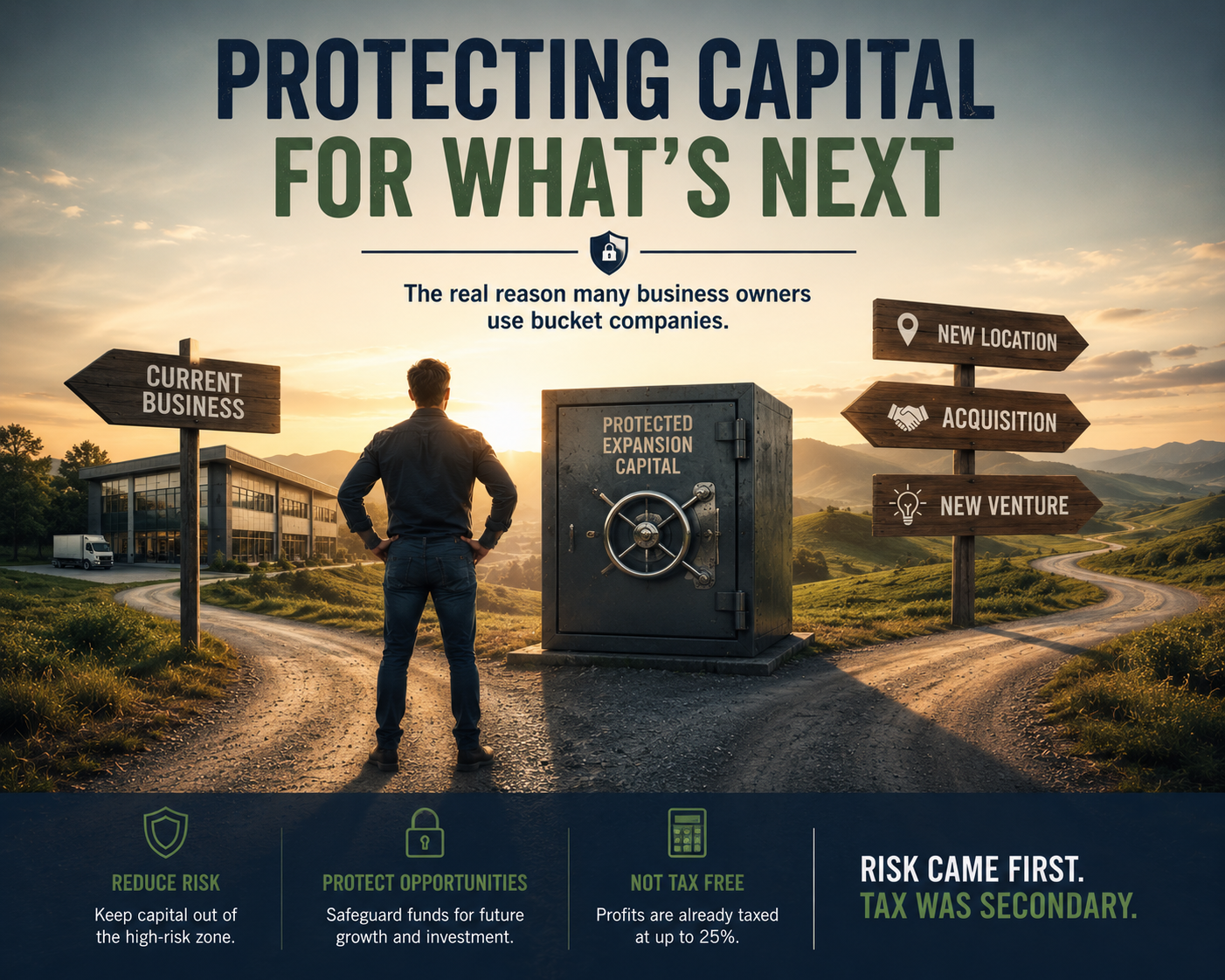
So many business owners choose to move profits that have been set aside for future investment into a separate company that does not trade.
To some people, this type of structure is known as a “bucket company”. The name sounds like it exists purely for tax purposes.
But in practice, many business owners use these companies for the same reason they use other business structures: risk management.
Think of it as taking cash out of the shop safe and moving it into a bank vault.
The money is still there.
It still belongs to the business group.
But it is no longer sitting in the highest-risk environment.
Importantly, this money is not tax-free. The profits have already been taxed, or will be taxed, at company tax rates, which for many small and medium businesses is currently 25%.
The purpose is not simply to accumulate wealth.
The purpose is often to protect capital that has already been earmarked for the next opportunity, whether that is a new location, a new product line, an acquisition or an entirely new business venture.
Many business owners are not trying to avoid tax. They are trying to protect the capital they have spent years building so they can invest it into future growth opportunities.
Risk came first. Tax was secondary.
Part 4: Small Business Succession Planning and Retirement in Australia
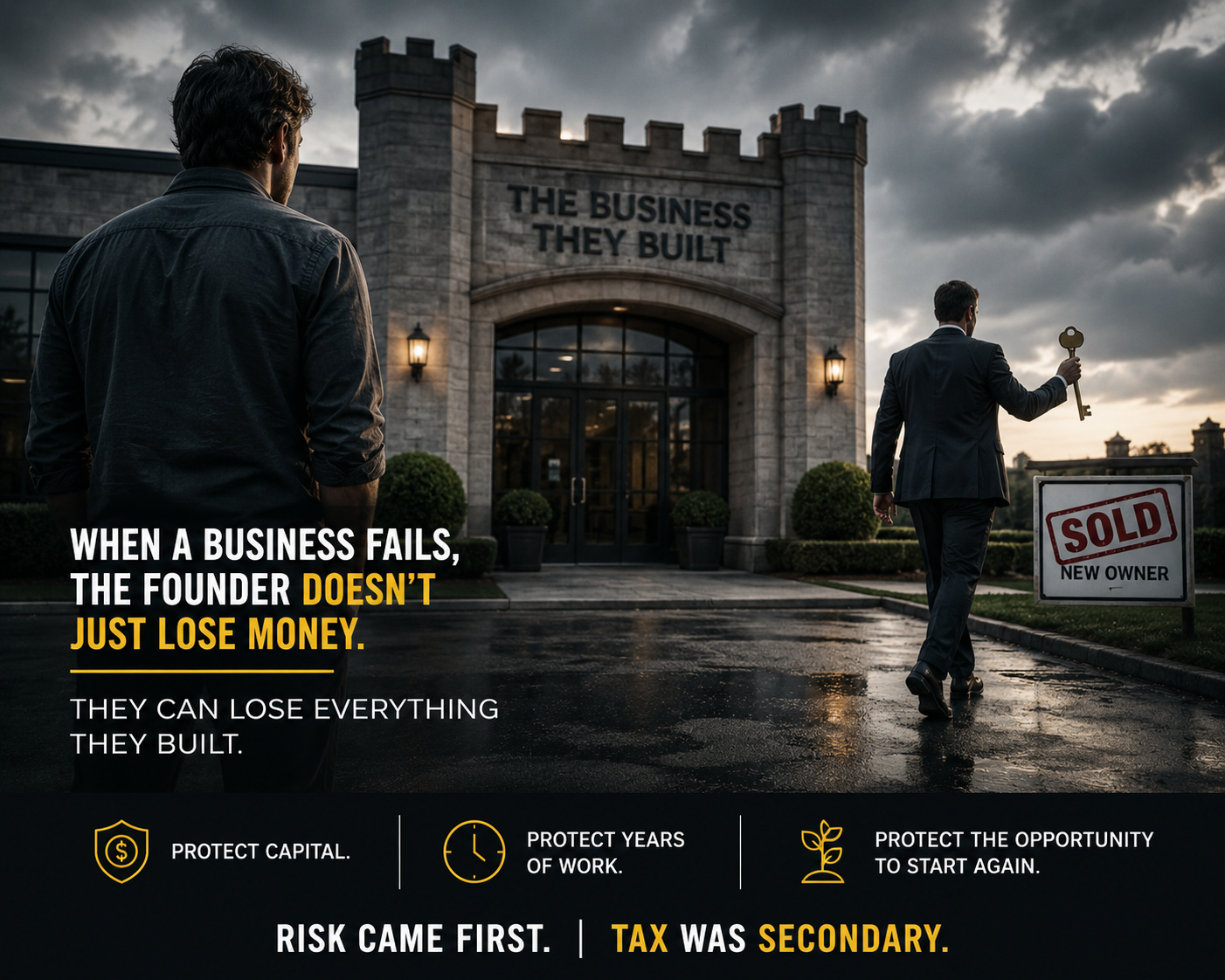
There is one final issue that rarely gets discussed. At some point every business owner exits.
Some sell. Some pass the business to family members. Some simply close the doors.
But regardless of the path, the business eventually changes hands.
For many owners, that exit is not a windfall.
It is their retirement plan.
Unlike employees who accumulate superannuation throughout their working lives, many business owners spend decades reinvesting profits back into their businesses.
They:
- take risks.
- build teams.
- invest in equipment.
- expand premises.
- create systems, intellectual property and customer relationships.
Over time, the business itself becomes the asset.
The challenge is that a business is only worth what somebody is prepared to pay for it.
And buying a business is not easy.
The buyer is often taking on significant debt, personal risk and years of responsibility.
They are committing capital that could have been invested elsewhere.
They are backing themselves to grow something they did not build.
That requires confidence.
It requires access to capital.
And it requires a belief that the rewards are worth the risk.
That point is important.
Most employees know exactly what they will be paid when they turn up to work tomorrow.
Most business owners do not.
Some businesses succeed. Many do not.
Some owners spend years building a business only to see it fail.
Others spend decades reinvesting profits back into the business rather than taking those profits home.
The possibility of eventually building a valuable business is one of the rewards for accepting that uncertainty.
Without the prospect of reward, fewer people will be willing to accept the risk in the first place.
And if fewer people are willing to take that risk, fewer businesses get started, fewer businesses get expanded and fewer businesses are available for the next generation to buy.
This becomes particularly relevant as a large number of business owners approach retirement over the coming decade.
Many successful businesses will come onto the market looking for a new owner.
The question is not whether those businesses have value.
The question is whether enough people will be willing to take the risk of buying them.
Because if enough buyers do not emerge, many of these businesses will not simply continue as they are.
Some will close.
Some will shrink.
Some will be absorbed by larger competitors.
Over time, industries can become increasingly concentrated in the hands of fewer and larger businesses.
That has consequences far beyond the business owner.
Less competition can mean fewer choices for consumers.
It can reduce innovation.
It can make it harder for new entrants to establish themselves.
And it can reduce the opportunities available to employees.
Small and medium businesses are often where future managers, tradespeople and business owners learn their craft.
They are where:
- apprentices receive their first opportunity.
- new ideas are tested.
- local jobs are created.
The next generation of business owners is not simply buying a business.
They are preserving:
- jobs.
- competition.
- opportunities for future workers, future apprentices and future entrepreneurs.
This is why the current debate matters.
The discussion should not only be about how much tax is collected today.
It should also be about whether we are creating an environment where people are willing to take the risks required to start, grow, invest in and eventually buy businesses.
Because when a business owner retires, the question is not whether the business has value.
The question is whether someone is willing to take the risk of owning it.

Part 5: Risk, Reward, and the Future of Business Investment in Australia
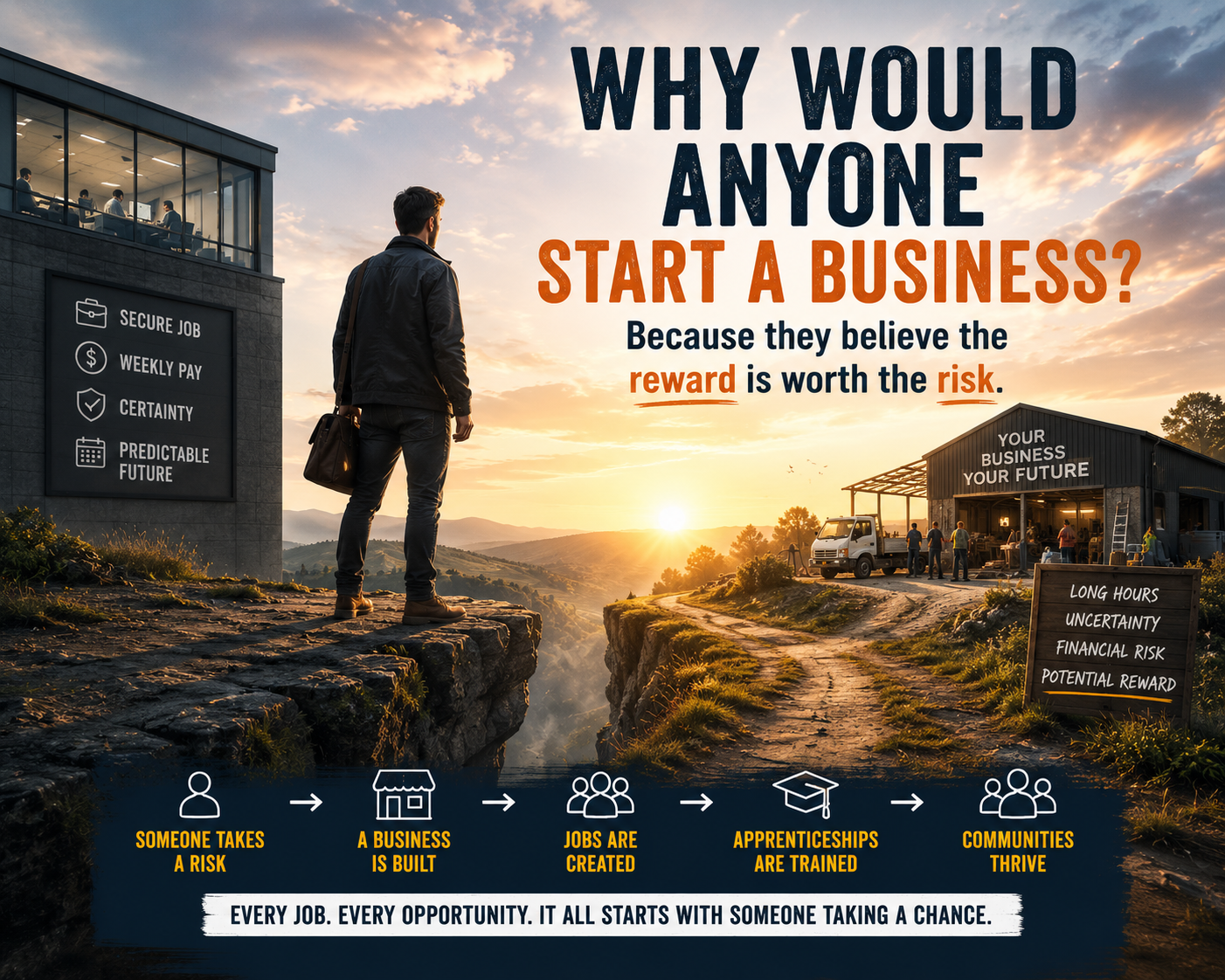
Every successful business starts with somebody taking a risk.
They:
- leave a secure job.
- invest their savings.
- work nights and weekends.
- are often paid less than their staff. And unlike their staff, there is no guarantee they will be paid at all.
- accept years of uncertainty.
And they do all of this knowing there is a very real chance they could fail.
The question is simple.
Why would someone choose that path?
The answer is because they believe the potential reward is worth the risk.
That principle applies whether someone is opening a local plumbing business, building a technology startup or buying an existing business from a retiring owner.
People take risks because they believe they can build something valuable.
But capital, talent and ambition are increasingly mobile.
A skilled founder can build a business in Australia.
They can also build one in the United States. Or Singapore. Or the United Kingdom.
Investors can deploy capital almost anywhere in the world.
The question therefore becomes broader than tax.
What makes Australia an attractive place to take those risks?
What makes:
- someone choose to build a business here rather than somewhere else?
- a young entrepreneur decide that years of uncertainty are worth it?
- What makes an investor back a startup instead of putting money into property, shares or overseas opportunities?
These are important questions because every successful business started with somebody taking a chance.
The jobs created later only exist because somebody accepted the risk at the beginning.
The:
- apprentices hired in five years.
- managers promoted in ten years.
- business eventually sold to the next generation.
All of that starts with one person deciding the reward is worth pursuing.
If we want strong local businesses, strong communities and strong employment opportunities, we need people willing to take those risks.
And that means understanding that risk and reward are not opposing concepts.
They are partners.
Without risk there is no growth.
Without reward there is little reason to take the risk.
Conclusion: What Is Really Being Debated?
When people hear discussions about trusts, companies, shareholder loans and bucket companies, it is easy to view them as tax structures.
But as these examples demonstrate, they are often something else entirely.
The company and trust protected a family.
The founder loan protected years of work and investment.
The bucket company protected capital earmarked for future growth.
The business sale represented the reward for decades of risk and reinvestment.
And every new business begins with somebody deciding that the potential reward is worth the risk.
That is why this debate matters.
Because it is not only about tax.
It is about risk.
It is about investment.
It is about entrepreneurship.
It is about whether people are willing to build businesses, employ staff, reinvest profits and eventually pass those businesses to the next generation.
The businesses discussed throughout this article are not abstract tax structures.
They are the businesses that employ local workers.
Train apprentices.
Support suppliers.
Sponsor sporting clubs.
And help keep communities strong.
Every one of them exists because somebody was willing to take a risk.
The real question is not how we tax success after it happens.
The real question is whether enough people will still be willing to take the risk of creating that success in the first place.
Frequently Asked Questions: TiE Women Global Pitch Competition 2026
Q Why do Australian businesses use a company structure instead of operating as a sole trader?
he primary reason is asset protection. Operating as a sole trader offers zero legal separation; your personal assets—including the family home—are entirely exposed if the business faces a lawsuit or financial distress. A proprietary limited (Pty Ltd) company operates as a separate legal entity, creating a vital commercial fence that protects your personal wealth from everyday business liabilities.
Q: How do discretionary trusts and companies work together for risk management?
Think of a company as a fence and a trust as a lock on the gate. While a trading company isolates business liabilities, if the shares of that company are owned by you personally, those shares are still exposed to personal lawsuits or bankruptcy. By having a discretionary trust own the company shares, you separate legal ownership from the trading risks, adding an extra layer of asset protection.
Q. What is a bucket company, and what is its primary purpose?
A bucket company (also known as a corporate beneficiary) is a separate company set up to receive profit distributions from a family trust. While it provides a practical tax benefit by capping the tax rate at 25% or 30% (rather than individual marginal rates up to 47%), its primary operational purpose is risk management. It allows a business group to securely move retained profits out of the high-risk trading entity—where customers, staff, and contracts live—and store them safely in a separate legal vault for future investment.
Q. Why would a founder fund their business via a secured loan rather than share capital?
Funding a business through a formal, secured loan agreement is a critical risk-mitigation strategy. If a business runs into financial trouble or enters voluntary administration, a founder who has invested via share capital ranks at the bottom of the list to recover funds. However, a founder who acts as a secured creditor holds significant legal influence over the administration process, making it much easier to protect intellectual property, recover key assets, or restart the venture.
Q. Doesn't comprehensive business insurance completely eliminate the need for these complex structures?
Insurance is your first line of defense, but it is not a replacement for a robust business structure. Insurance policies have caps, exclusions, and conditions. If a claim exceeds your policy limit, or if an insurer refuses a claim due to a technicality, the remaining liability falls back on the business. Structure acts as the ultimate safety net when insurance runs out or fails
Q If I trade through a company, can the ATO still come after my personal assets?
Yes, the corporate veil is not entirely bulletproof. Under the ATO’s Director Penalty Notice (DPN) regime, company directors can be held personally liable for unpaid business liabilities such as Pay As You Go (PAYG) withholding, Goods and Services Tax (GST), and Superannuation Guarantee Charge (SGC). Good structure protects you from commercial market risks, but it does not protect you from statutory tax and superannuation non-compliance.
Q Can I just transfer the family home into my spouse’s name to protect it from business risks?
While transferring assets to a “non-risk” spouse is a common strategy in Australia, timing is everything. Under bankruptcy laws, courts and bankruptcy trustees can look back and overturn asset transfers if they believe the transfer was done to defeat creditors. Furthermore, transferring a property can trigger significant stamp duty and Capital Gains Tax (CGT) consequences if not planned correctly. It needs to be done well before any risk or insolvency issues appear on the horizon
Q Are there extra costs and administrative burdens associated with running these structures?
Yes. Operating a combination of trusts, trading companies, and bucket companies involves higher upfront setup fees, annual ASIC review fees, separate bank accounts, and additional tax return compliance. However, for an expanding business, this increased administrative cost is best viewed as an insurance premium to secure the millions of dollars in personal wealth and commercial capital you are actively building.
Wayne Wanders is an experienced Business Advisor and Outsourced CFO who can help to scale and grow your business profitably.
Contact Wayne on wayne@arealcfo.com.au or 0412 227 052.
Click on the below buttons to access free Resources developed by Wayne Wanders, A Real CFO to help your business scale and grow profitably
And Wayne is always posting about new grants, funding options and other resources on LinkedIn that can help your business scale and grow profitably. Click on the below links and connect with Wayne or follow A Real CFO on LinkedIn.
Want a confidential discussion on your business situation, help with your grant application or to learn more about my Outsourced CFO Services, simply email me at wayne@aRealCFO.com.au or call me on 0412 227 052
