
CFO Thinking: How Better Decisions Get Made Under Uncertainty
Most business decisions aren’t made with perfect information.
There are time constraints. Conflicting data. Real consequences.
CFO thinking is about making better decisions when the numbers aren’t clear and the stakes are real.
It’s not about reporting. It’s about judgement.
Here are 12 principles that shape how better decisions get made.
1. What CFO Thinking Actually Is
Most people think a CFO is about reporting.
Budgets. Forecasts. Variance analysis.
That’s not it.
CFO thinking is about decision quality under uncertainty.
Because in business:
• You rarely have perfect data
• Time is always limited
And the quality of your decisions determines the quality of your outcomes.
2. Every Decision Is a Trade-Off
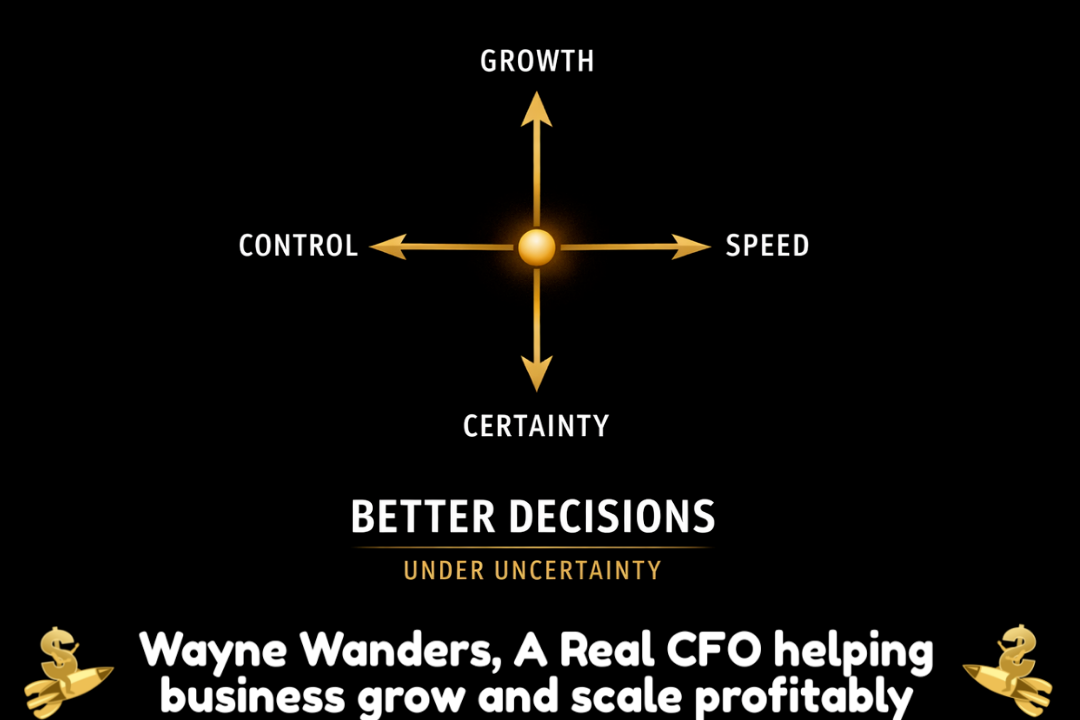
There is no perfect decision. Only trade-offs.
More growth usually means more risk.
More control often slows scaling.
More profit can mean saying no to revenue.
Every decision reallocates risk, capital, or time — whether you acknowledge it or not.
CFO thinking forces clarity:
What are we willing to give up?
3. The Cost of Waiting
There’s always a reason to wait.
More data. More clarity. Better timing.
But while you wait:
• Opportunities disappear
• Problems compound
• Options narrow
Delay isn’t neutral. It has a cost.
Indecision is still a decision — just rarely the one you intended to make.
4. The 80% Rule
Most decisions are made too late.
Waiting for certainty kills momentum.
The 80% rule is simple:
If you have enough information to be directionally right, move.
You can adjust faster than you can analyse.
Speed creates advantage. Delay creates drag.
5. The Numbers Don’t Decide, You Do
Numbers don’t give answers. They give context.
Two people can look at the same data and make completely different decisions.
Because numbers don’t remove judgement.
At some point, you have to commit.
That’s where decisions are actually made.
6. The Hidden Assumptions Behind Every Plan
Every plan is built on assumptions.
Revenue will grow.
Costs will hold.
Customers will behave as expected.
None of these are guaranteed.
The better question is:
What has to be true for this to work?
Because when assumptions shift, outcomes change quickly.
7.Cash Is the Constraint
Profit looks good. Cash keeps you alive.
You can be profitable and still run out of money.
Why? Timing.
Cash in rarely matches cash out.
CFO thinking focuses on when cash moves — not just what the P&L says.
Because once cash is tight, your options disappear.
8. When Growth Becomes a Risk
Growth sounds like progress. But it changes the business.
More people. More cost. More complexity.
Often:
• Margins tighten
• Systems strain
• Visibility drops
Growth doesn’t just create upside. It increases exposure.
The real question is: can the business actually handle it?
9. The Danger of “We Can Afford It”
“We can afford it” is how a lot of bad decisions start.
Affordability is not a strategy.
You can afford the wrong hire.
The wrong system.
The wrong expansion.
The better question is not “can we afford it?”
It’s “is this the right decision?”
10. Scenario Thinking
Good CFOs don’t predict the future. They prepare for it.
What if revenue drops?
What if demand spikes?
What if costs increase?
Scenario thinking isn’t about being negative. It’s about being ready.
The goal isn’t certainty. It’s flexibility.
11. Founder Bias
The biggest risk isn’t always external. It’s internal.
Founders back themselves. That’s the point.
But bias shows up:
• Overconfidence
• Ignoring signals
• Holding on too long
Belief and reality don’t always match.
Good decision-making requires challenging your own assumptions — not just defending them.
12. From Numbers to Action
Most businesses don’t lack insight. They lack action.
They know:
• Where margins are tight
• Where costs are creeping
• Where performance is slipping
But nothing changes.
CFO thinking closes the gap:
What decision are we making today?
Because numbers only matter when they lead to action.
Final Thought
Better businesses aren’t built on perfect information.
They’re built on better decisions.
CFO thinking is about improving decision quality under pressure, when the data is incomplete, the timing matters, and the stakes are real.
If you’re working through decisions like this, it’s worth stepping back and looking at them properly.
Wayne Wanders is an experienced Business Advisor and Outsourced CFO who can help to scale and grow your business profitably.
Contact Wayne on wayne@arealcfo.com.au or 0412 227 052.
Click on the below buttons to access other free Resources developed by Wayne Wanders, A Real CFO to help your business scale and grow profitably
Want a confidential discussion on your business situation, help with your grant application or to learn more about my Outsourced CFO Services, simply email me at wayne@aRealCFO.com.au or call me on 0412 227 052
