

Contractor or employee? Here are 8 factors regulators look at.
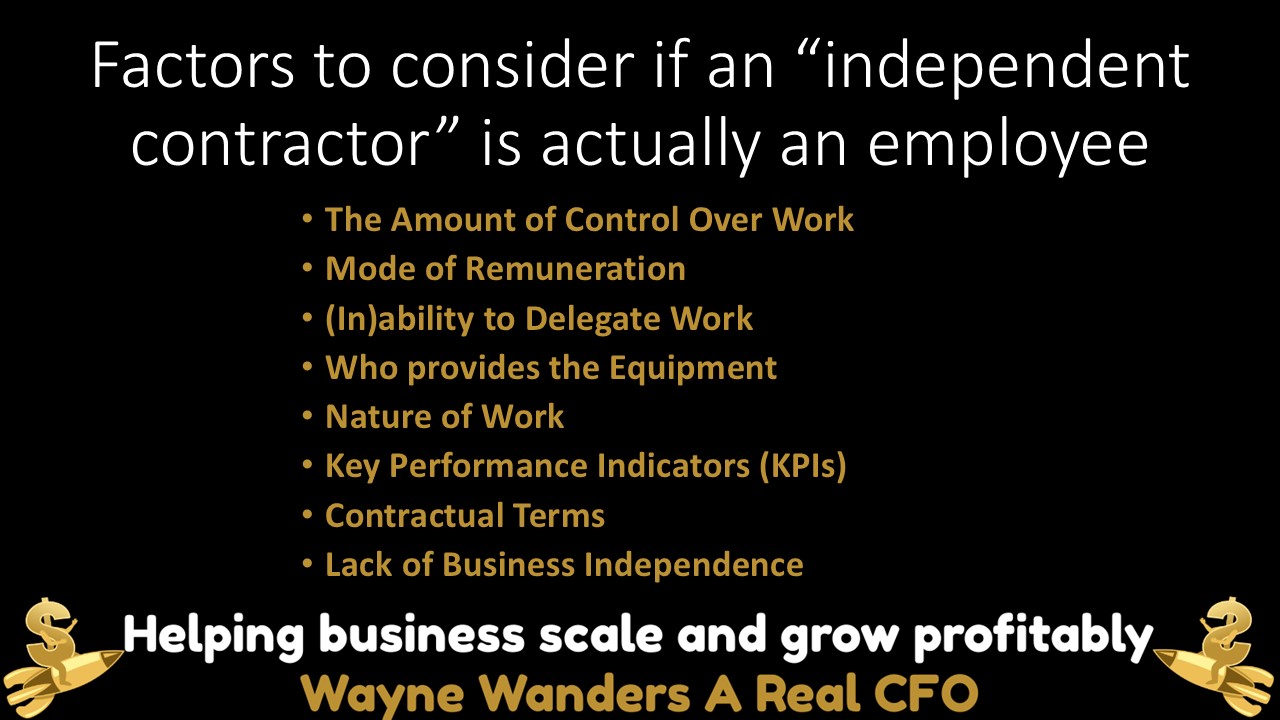
Following changes to employment laws and the crackdown by the ATO and FairWork on sham contracting, the distinction between employees and contractors is becoming more important for business owners.
Under the Fair Work Act 2009, regulators don’t rely on a single test. Instead, they look at the totality of the relationship.
The Fair Work Ombudsman and courts commonly examine factors such as:
- Control over the work – The more the business directs how work is done, the more it resembles employment.
- Mode of remuneration – Hourly or wage-style payments often indicate employment rather than contracting.
- Ability to delegate – Independent contractors can usually subcontract or delegate the work.
- Provision of equipment – Employees typically use tools and equipment supplied by the business.
- Nature of the work – Is the person providing a separate professional or trade service, or filling a role within the organisation?
- Performance expectations – Daily operational KPIs may suggest employment, while outcome-based deliverables are more consistent with contracting.
- Contractual terms – The agreement still matters, but it is no longer the deciding factor.
- Business independence – Is the person genuinely running their own business with multiple clients?
No single factor determines the answer.
What matters is the overall substance of the relationship.
A useful question for business owners to ask is:
“Does this person look like they run their own business, or do they look like part of ours?”
If the answer isn’t clear, the arrangement may be worth reviewing.
One additional point from the recent reforms. Changes introduced a high-income contractor opt-out.
If an individual contractor earns above the contractor high income threshold (currently $183,100 per year for the 2025-26 tax tear), they may choose to opt out of the new employment test by providing a written notice.
Importantly, the contractor can withdraw that opt-out notice at any time.
For many businesses, however, the practical question will still come back to the same issue:
A simple rule of thumb:
If the person looks like part of your organisation, regulators will likely view them as an employee.
If they look like they run their own business, they’re more likely to be a contractor.
Does this person genuinely run their own business, or do they look like part of yours?
Contact Wayne on wayne@arealcfo.com.au or 0412 227 052.
Click on the below buttons to access other free Resources developed by Wayne Wanders, A Real CFO to help your business scale and grow profitably
Want a confidential discussion on your business situation, help with your grant application or to learn more about my Outsourced CFO Services, simply email me at wayne@aRealCFO.com.au or call me on 0412 227 052
