
Fair Work Wage Increase 2026: A Payroll Checklist for Australian Employers
The Fair Work Commission’s (FWC) Annual Wage Review decision takes effect from 1 July 2026. If your business employs staff under a modern award or relies on the National Minimum Wage, now is the critical window to audit your payroll systems and ensure strict compliance.
A common mistake among business owners is assuming that every employee simply receives a flat 4.75% increase. That is not the case for the 2026 financial year. Under the FWC’s latest structural adjustments, some employees on the lowest award classifications will receive a higher, targeted increase than the standard headline rate due to the Stage 1 phase-out of the C13 classification.
Failing to adjust these specific pay scales correctly places businesses at severe risk of involuntary underpayment claims and Fair Work Ombudsman (FWO) penalties.
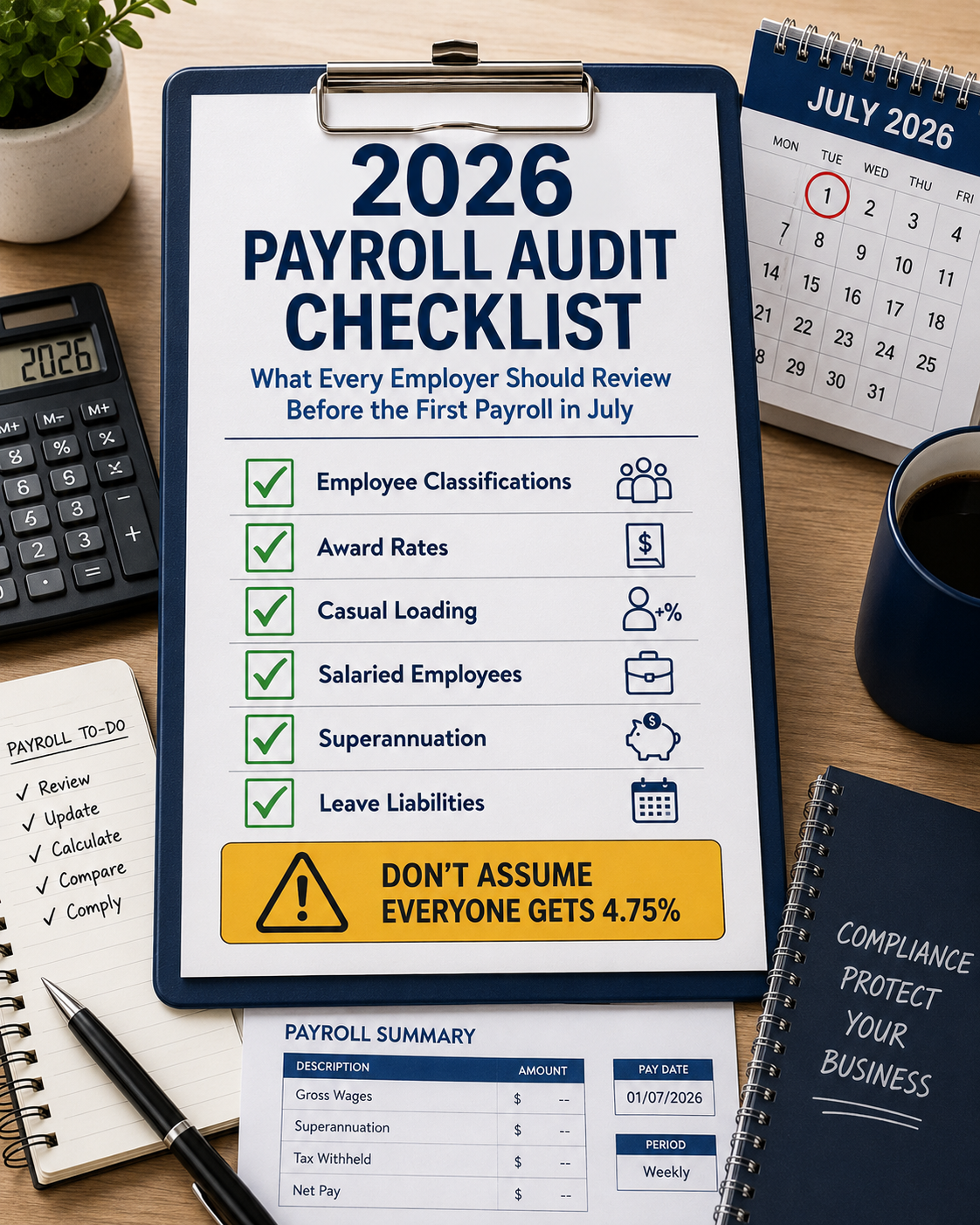
📋 Your 1 July 2026 Payroll Audit Checklist
To safeguard your business against compliance issues, employers should execute a mini payroll audit before processing the first pay cycle in July. Follow these six essential steps:
Confirm Each Employee’s Modern Award Classification
Do not assume last year’s classifications still apply. Review staff roles to ensure their daily duties still align with their current award definitions. Pay close attention to employees who have:
- Taken on more responsibility
- Aged up (junior rates)
- Completed apprenticeships
Any of these milestones may automatically bump them into a higher pay bracket.
Source Official 2026 FWO Pay Guides
Avoid relying on third-party calculators or outdated blogs. Download the official, updated pay guides directly from the Fair Work Ombudsman (FWO) website as soon as they are published in mid-June. Ensure you are looking specifically at the rates marked effective 1 July 2026.
Run Comparative Pay Rate Audits
Line up your existing employee base hourly rates against the newly mandated minimums.
- National Minimum Wage: Ensure anyone on the base rate is moved to $26.44 per hour ($1,004.90 per week).
- Casual Employees: Remember that casual loading (typically 25%) must be recalculated based on the new, higher base rate.
Review Salaried and Annualised Wage Arrangements
If you pay staff an all-inclusive annual salary, you must perform a reconciliation. Ensure that the annual salary is still high enough to cover the new minimum award rates, including any overtime, weekend penalty rates, or allowances the employee actually worked. If the new award minimum outpaces the salary, you must top it up.
Forecast On-Costs (Superannuation & Leave Liabilities)
A wage increase does not happen in a vacuum. It triggers a cascading financial impact across your entire business overhead. Remember to factor in:
- Superannuation Guarantee (SG): Ensure your cash flow accounts for both the higher gross wage and your super obligations.
- Leave Liabilities: Long service leave and annual leave balances must be revalued on your balance sheet to reflect the new, higher hourly pay rates.
- Payroll Tax and Workers’ Compensation: Higher wages will incrementally bump up your state payroll tax obligations and insurance premiums.
⚖️ Do You Have to Increase Above-Award Pay?
A frequent point of confusion for employers is whether the 2026 wage increase applies to staff members who are already paid above the minimum rate.
The short answer: The Annual Wage Review legally changes the minimum safety net.
If an employee is already paid a flat contract rate that sits safely above the newly revised 2026 minimum award rate (including all applicable allowances and penalties), there may not be a legal requirement to increase their pay.
⚠️ Warning: Do Not Guess the Math
Every employee must be reviewed individually. If an above-award rate is absorbed by the new increase, the buffer you once had shrinks. If that employee works significant overtime or night shifts, their flat rate might suddenly fall below the new legal minimum.
The businesses that find themselves facing costly back-pay orders are rarely malicious; they are usually the ones that assumed the changes didn’t apply to them because they “pay well.” Taking a few hours to meticulously audit your payroll data now is the only way to prevent a systemic underpayment issue later.
Wayne Wanders is an experienced Business Advisor and Outsourced CFO who can help to scale and grow your business profitably.
Contact Wayne on wayne@arealcfo.com.au or 0412 227 052.
Click on the below buttons to access free Resources developed by Wayne Wanders, A Real CFO to help your business scale and grow profitably
And Wayne is always posting about new grants, funding options and other resources on LinkedIn that can help your business scale and grow profitably. Click on the below links and connect with Wayne or follow A Real CFO on LinkedIn.
Want a confidential discussion on your business situation, help with your grant application or to learn more about my Outsourced CFO Services, simply email me at wayne@aRealCFO.com.au or call me on 0412 227 052
