

How My Bucket Accounting System Helps You Grow Profitably (and Avoid Growing Broke)
In a recent conversation about profitable growth, I made a simple but confronting point:
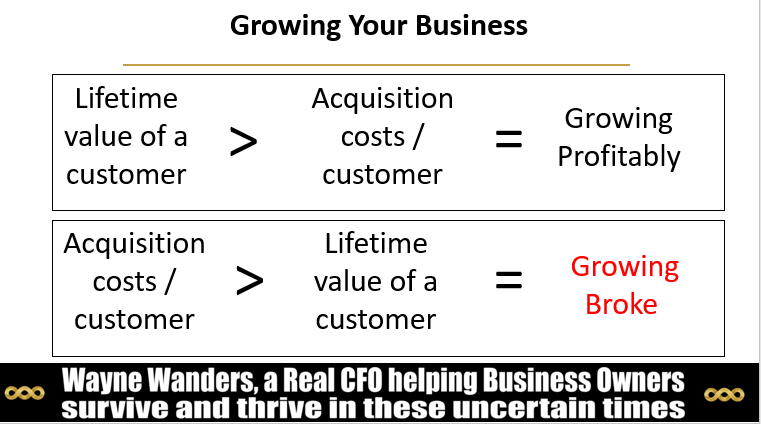
If the money, time, and effort you spend to acquire a customer is more than the money you make from that customer, your business may be growing, but you are growing broke.
Most business owners feel this problem long before they can see it. Revenue is rising, the team is busier than ever, yet cash is tight, stress is high, and profit never quite shows up the way it should.
The reason is almost always the same.
They are making decisions without the right numbers.
That is exactly the problem my Bucket Accounting System is designed to solve.
The Real Question Behind Profitable Growth
To understand whether you are growing profitably or growing broke, you need to be able to answer two questions with confidence:
- What does it cost me to acquire a customer?
- What is that customer actually worth to me over their lifetime?
In theory, these sound like basic business questions.
In practice, very few accounting systems are set up to answer them.
Why Traditional Accounting Doesn’t Give You the Answers
Most small businesses use accounting software like Xero or MYOB with a standard chart of accounts. Expenses are recorded alphabetically, from accounting fees through to wages.
The problem is that alphabetical accounting tells you what you spent money on, not why you spent it.
Take wages as a simple example. In most systems, there is one wages account, but inside that single number are the costs of:
- Salespeople acquiring new customers
- Staff delivering the product or service
- Team members retaining and supporting customers
- Admin staff supporting the business as a whole
Those costs behave very differently, but traditional reports lump them together. As a result, you cannot clearly see what drives profit, what drives growth, and what quietly destroys cash.
This is where you need to stop thinking in alphabetical order and start thinking in buckets.
Introducing My Bucket Accounting System
The Bucket Accounting System reorganises your numbers around how your business actually works and how you actually make decisions.
Instead of asking, “What did we spend money on?”, it helps you answer,
“Which activities created value and which ones didn’t?”
Step 1: Create Buckets That Reflect Your Business
Your first set of buckets should mirror the way you naturally review your business. This might be:
- By product or product group
- By distribution channel (retail vs wholesale, online vs offline)
- By geography
- By customer segment
If you use more than one lens, you can make one a sub-bucket of another.
Once these buckets are defined, all revenue and costs are allocated to the appropriate bucket.
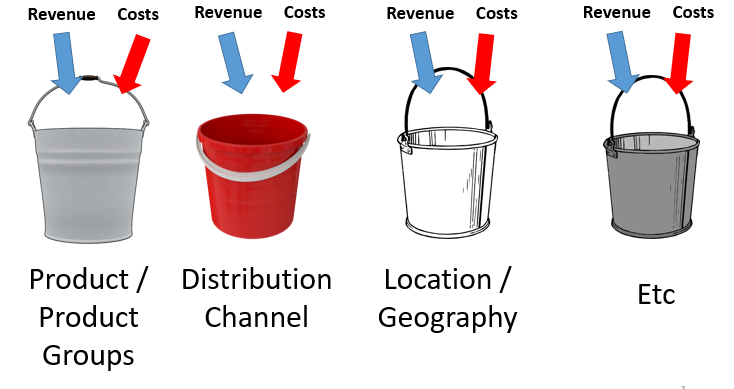
The result is powerful. You now have, in effect, a mini profit and loss statement for each part of your business.
This immediately allows you to:
- Identify your most profitable segments and lean into growing them
- See which segments need improvement before further growth
- Seriously question whether some segments should be fixed or shut down
Step 2: Break Each Bucket into Meaningful Cost Categories
Even with segmented profit and loss statements, you still cannot tell whether growth within a segment is profitable without going deeper.
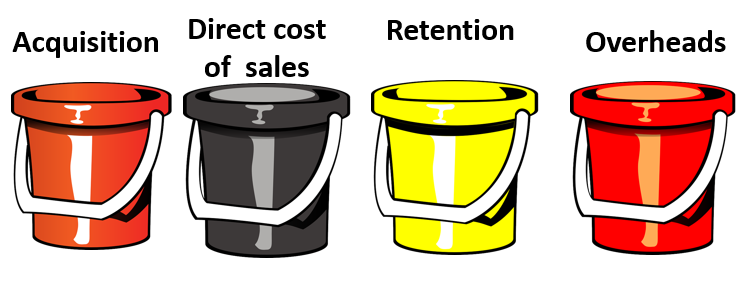
Within each bucket, I typically split costs into four sub-buckets:
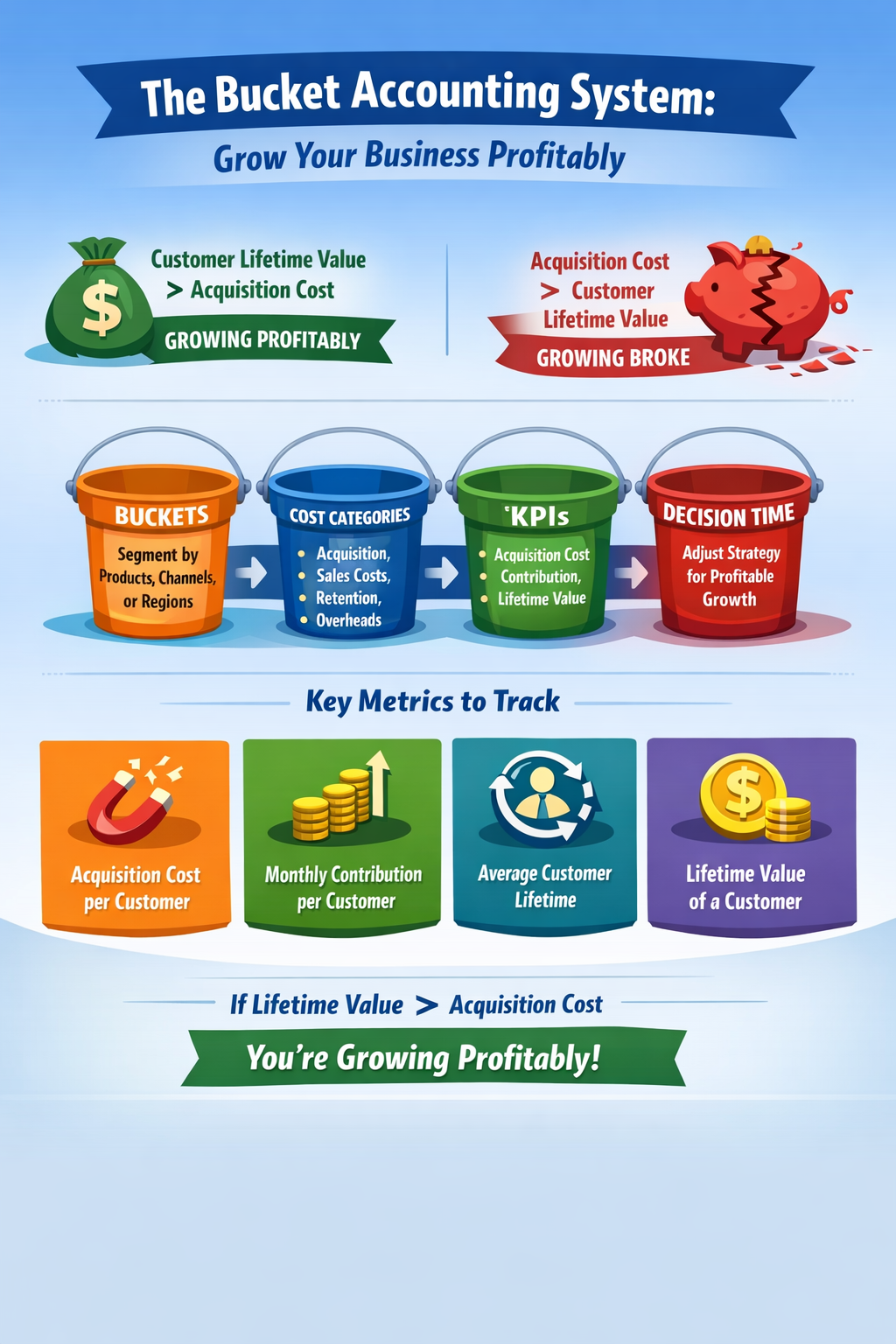
Customer Acquisition
All costs associated with winning a customer. This includes marketing, sales salaries, commissions, referral fees, and any other cost incurred before a customer starts paying you.
Direct Costs of Sales
The direct cost of delivering the product or service. This could be product purchase costs, warehousing, delivery, or the cost of staff delivering a service.
Customer Retention
The costs required to keep customers. Customer service, account management, onboarding, and ongoing support all sit here.
Overheads
All remaining administration and business-wide support costs.
Now your numbers start to tell a story rather than just record history.
Step 3: Use the Buckets to Calculate the KPIs That Matter
Once your buckets are in place, the most important growth KPIs become easy to calculate.
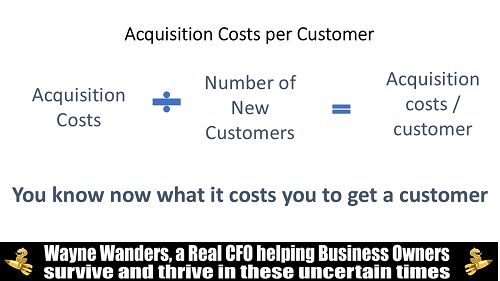
Step 3a: Acquisition Cost per Customer
Add up all acquisition costs for the period and divide by the number of new customers acquired.
You now know exactly what it costs to win a customer.
Step 3b: Monthly Contribution per Customer
Monthly contribution is calculated as:
Revenue minus direct costs of sales, minus an appropriate share of retention costs and applicable fixed costs.
Divide this by the number of customers to determine the monthly contribution per customer.
This tells you how much each customer contributes before growth costs.
Step 3c: Average Customer Lifetime
How long does a customer stay with you?
One month, six months, a year, or longer?
This is often guessed in businesses that do not track it properly.
Step 3d: Lifetime Value of a Customer
Lifetime value is simply:
Monthly contribution × average customer lifetime
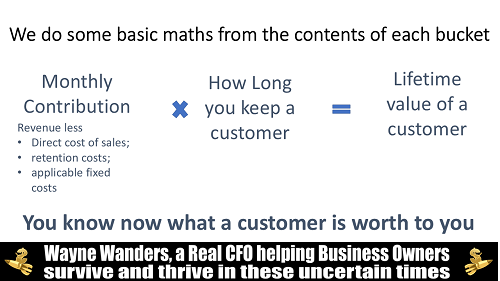
Now you know what a customer is actually worth to your business.
Step 4: The Moment of Truth — Are You Growing Profitably?
With these numbers in place, the answer becomes clear.
- If customer lifetime value is greater than acquisition cost, you are growing profitably.
- If acquisition cost is greater than customer lifetime value, you are growing broke.
If you are growing broke, the solution is not to “sell harder”.
The Bucket Accounting System shows you exactly where to pull the levers, including:
- Increasing revenue per customer
- Improving retention and customer lifetime
- Reducing delivery costs
- Reducing acquisition costs
- Or a combination of all of the above
Growth without this clarity is gambling. Growth with this clarity is a strategy.
Final Thought
Most business owners do not fail because they lack effort or ambition.
They fail because their numbers do not give them the insight they need to make good decisions.
My Bucket Accounting System turns your accounting data into a decision-making tool that helps you grow profitably, sustainably, and with confidence.
If you would like help working out what your buckets should be and how to implement this in your business, feel free to get in touch.
Contact Wayne on wayne@arealcfo.com.au or 0412 227 052.
Click on the below buttons to access other free Resources developed by Wayne Wanders, A Real CFO to help your business scale and grow profitably
Want a confidential discussion on your business situation, help with your grant application or to learn more about my Outsourced CFO Services, simply email me at wayne@aRealCFO.com.au or call me on 0412 227 052
