

RBA Card Fee Changes Explained: Why Lower Merchant Fees Could Hurt Your Margins
The Reserve Bank of Australia is cutting interchange fees and banning surcharges, but the real impact on business margins is often misunderstood.
The End of “Pass-Through” Card Fees
For years, many Australian businesses have treated card fees as a pass-through cost.
Customer pays by card → fee gets added → business stays whole.
Simple.
But recent changes from the Reserve Bank of Australia are about to fundamentally reset that model.
From 1 October 2026, two things happen at once:
- Interchange fees are cut significantly, with the interchange component dropping from around 0.8% → 0.3%
- Card surcharges are banned
This changes how many businesses manage pricing, margins, and profitability.
What Are Merchant Fees in Australia?
Breaking Down the Typical 1.8% Merchant Fee
Let’s start with the headline number most businesses recognise:
“I pay about 1.8% in merchant or card fees in Australia.”
That 1.8% isn’t one fee, it’s a bundle:
- ~0.8% interchange fees (set within the payments system)
- ~1.0% made up of card network fees (e.g. Visa, Mastercard) and your provider’s margin
How the RBA Interchange Fee Changes Impact Your Costs
In simple terms, your total cost does fall.
Using the example above:
1.8% → ~1.3% (if interchange savings are fully passed through)
So yes, your costs reduce by around 0.5%.
But that’s only half the story.
The Hidden Impact of the Credit Card Surcharge Ban
Why Lower Fees Don’t Always Mean Higher Profit
If you were already absorbing merchant fees:
👉 Good outcome, your costs fall and your margin improves.
But if you were passing on credit card surcharges:
- 👉 Your costs drop 0.5%
- 👉 Your revenue drops 1.8%
That’s a net negative impact on margin.
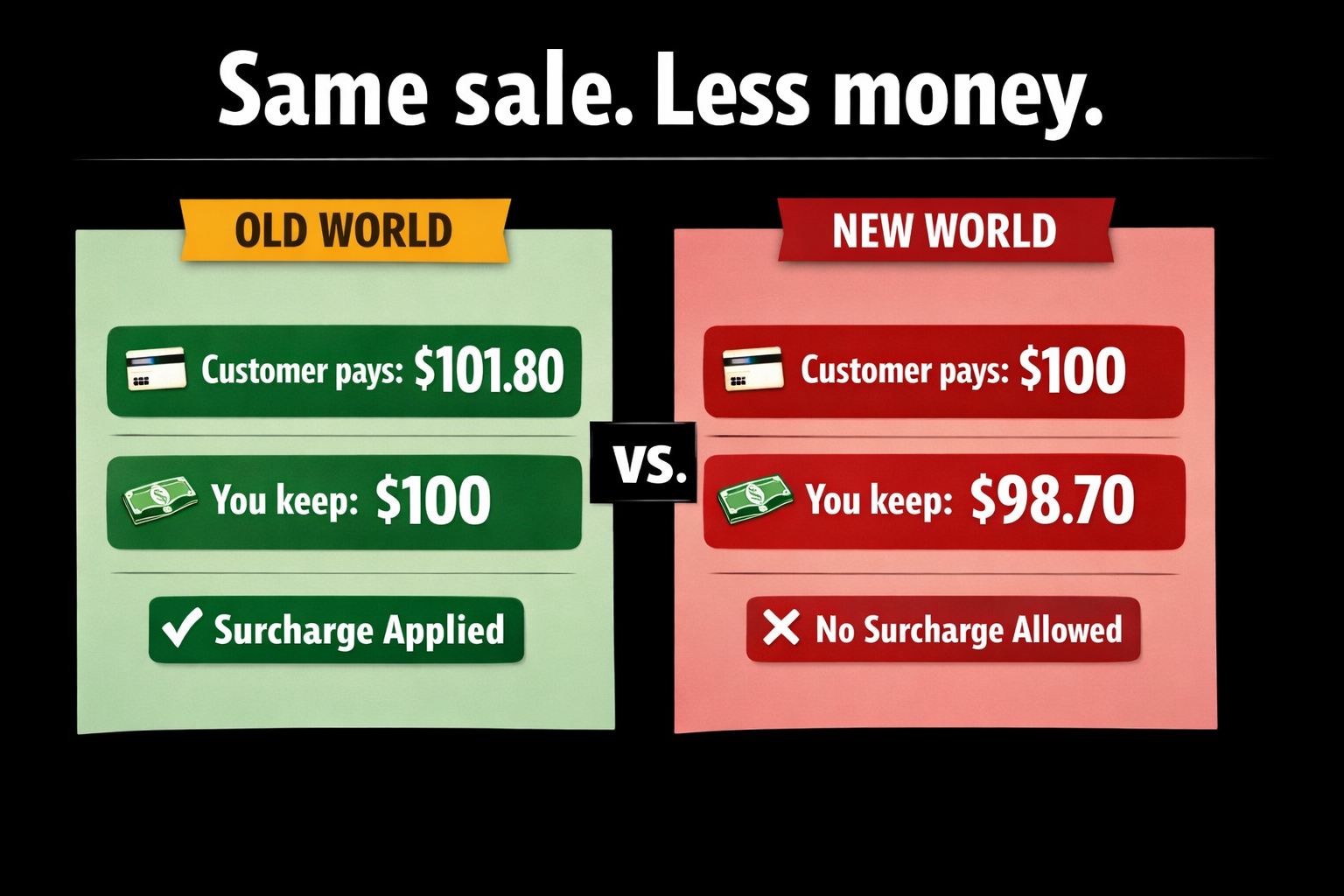
Example: How the Surcharge Ban Affects a $100 Sale
Old vs New Payment Economics
Let’s say you sell something for $100.
Old world (with surcharge):
- Customer pays: $101.80
- You receive: $100
New world (no surcharge):
You now have two choices.
Option 1: Absorb the cost
- Customer pays: $100
- You receive: ~$98.60–$98.80
Option 2: Adjust pricing
- Customer pays: ~$101–$102
- You maintain your margin
How to Reduce Merchant Fees in Australia
If you’re currently passing on merchant fees, you need to act, not drift.
1. Review Your Payment Provider
Many businesses haven’t focused on their merchant rate because:
“It was always passed on anyway.”
That mindset no longer works.
2. Reduce Your Underlying Payment Costs
Start with:
- Least-cost routing (debit over credit)
- Lower-cost providers
- Alternative payment methods like PayID and Osko
3. Rethink Your Pricing Strategy
You have two options:
- Do nothing → your margins fall
- Adjust pricing → recover some or all of the cost
But make it a conscious decision.
What Businesses Should Do Before October 2026
- Review your merchant fee structure
- Understand your payment mix (debit vs credit)
- Model the impact on margins
- Decide how you will adjust pricing
The Bottom Line on RBA Card Fee Changes
Yes, merchant fees in Australia are coming down.
But the bigger shift is this:
You’re losing the ability to pass them on.
What was once a neutral cost is now a direct margin decision.
Ignore it, and you will feel it.
Manage it, and you can come out ahead.
Next Steps
If you want to review your current merchant costs, speak to a provider like Shabaas Pay (full disclosure: a business I work with).
If you want help working through what this means for your pricing and margins, feel free to reach out.
Wayne Wanders is an experienced Business Advisor and Outsourced CFO who can help to scale and grow your business profitably.
Contact Wayne on wayne@arealcfo.com.au or 0412 227 052.
Click on the below buttons to access other free Resources developed by Wayne Wanders, A Real CFO to help your business scale and grow profitably
Want a confidential discussion on your business situation, help with your grant application or to learn more about my Outsourced CFO Services, simply email me at wayne@aRealCFO.com.au or call me on 0412 227 052
