

Venture Debt: When It Makes Sense and When It Doesn’t
Different Types of Funding for Your Business: A Practical Guide for Founders and SMEs — Part 5
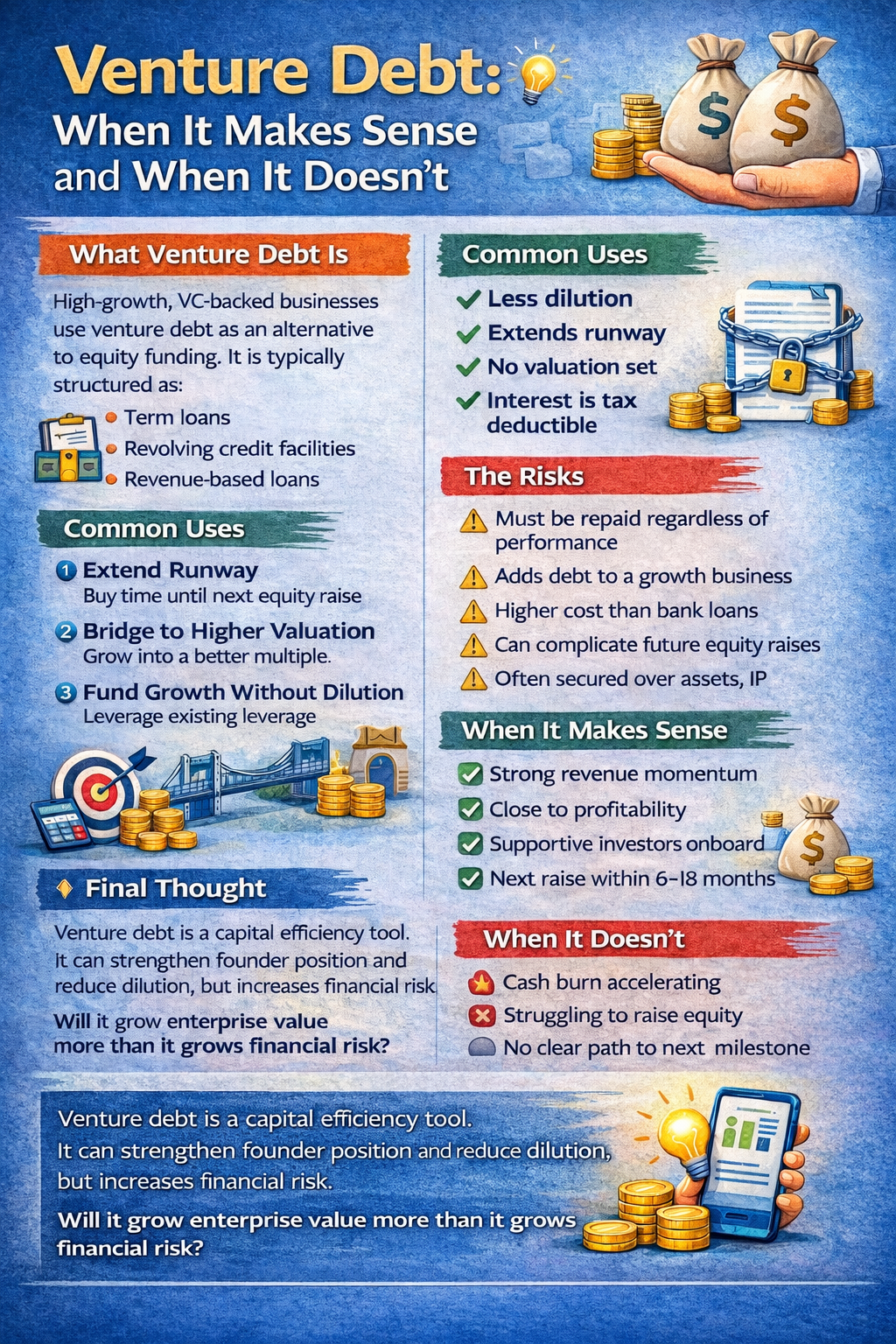
Venture debt is not cheap bank money. And it is not replacement equity.
Used properly, it is a strategic tool to extend runway, reduce dilution and increase founder leverage.
Used poorly, it creates pressure at the worst possible time.
Here’s what founders and business owners need to understand.
What Venture Debt Actually Is
Venture debt is typically provided to businesses that already have some form of equity investors.
It usually structured as:
🔹 Term loans
🔹 Revolving credit facilities
🔹 Revenue-based loans
Providers are often specialist venture debt funds, private credit investors or family offices. This includes Partners for Growth, OneVentures, Mighty Partners, Tractor Ventures and Lighter Capital.
This is not your local bank overdraft.
Why Founders Use It
There are usually three reasons:
- Extend Runway – You are 9–12 months from your next raise and want more time to hit milestones.
- Bridge to a Higher Valuation – You believe another 6–9 months of growth materially improves valuation.
- Fund Growth Without Further Dilution – You want to preserve equity while accelerating expansion.
If growth continues, venture debt can improve return on equity.
If growth stalls, it magnifies stress.
How It Is Structured
Venture debt usually includes:
🔹 A defined loan term
🔹 Interest payments, sometimes partly capitalised
🔹 Security over business assets
🔹 Financial covenants
🔹 Often warrants or a small equity upside component (debt providers may want a slice of upside in exchange for risk).
The Advantages
✅ Reduces immediate dilution
✅ Extends runway without a priced round
✅ Can improve negotiating position for next raise
✅ Interest is generally tax deductible
✅ Typically fewer control rights than new equity investors
In the right circumstances, it buys time and leverage.
The Risks
⚠️ Must be repaid regardless of performance
⚠️ Adds fixed obligations to a growth business
⚠️ Higher cost than traditional bank lending
⚠️ Can complicate future equity raises
⚠️ Security may include IP and core assets
Venture debt assumes future growth. If that growth does not materialise, the pressure compounds quickly.
When It Makes Sense
Venture debt tends to work best when:
📈 You have strong revenue momentum
📊 You are close to profitability or clear milestones
🤝 You have supportive existing investors
⏳ You are raising again within 6–18 months
It is a strategic bridge. It is not survival funding.
When It Doesn’t
It is usually a mistake when:
🚨 Cash burn is accelerating without visibility
❌ You are struggling to raise equity
🌫 There is no clear path to the next milestone
🧱 The debt is being used to delay hard decisions
Debt does not fix a broken model. It amplifies it.
Final Thought
Venture debt is a capital efficiency tool.
It can strengthen founder position and reduce dilution when used intentionally.
But it increases risk and reduces flexibility.
Before taking it on, the real question is: “Will this debt increase enterprise value more than it increases financial risk?”
If the answer is not clear, it is not the right time.
If you are considering venture debt, the structure matters more than the headline rate.
I work with founders and business owners to model:
📊 Runway impact
⚖️ Covenant risk
💰 Dilution comparisons versus equity
🔎 Downside scenarios if growth slows
If you are weighing up venture debt versus raising equity, reach out.
Wayne Wanders is an experienced Business Advisor and Outsourced CFO who can help to scale and grow your business profitably.
Contact Wayne on wayne@arealcfo.com.au or 0412 227 052.
Click on the below buttons to access other free Resources developed by Wayne Wanders, A Real CFO to help your business scale and grow profitably
Want a confidential discussion on your business situation, help with your grant application or to learn more about my Outsourced CFO Services, simply email me at wayne@aRealCFO.com.au or call me on 0412 227 052
