
Why VCs Need High Potential Returns
Venture capital is not designed to produce average outcomes.
In a typical VC portfolio:
❌ Some companies fail completely
🔁 Some return 1x to 3x
📈 A few perform well but not exceptionally
🚀 One or two must generate the majority of the fund’s return
This is power-law economics.
Here is what that actually looks like in numbers.
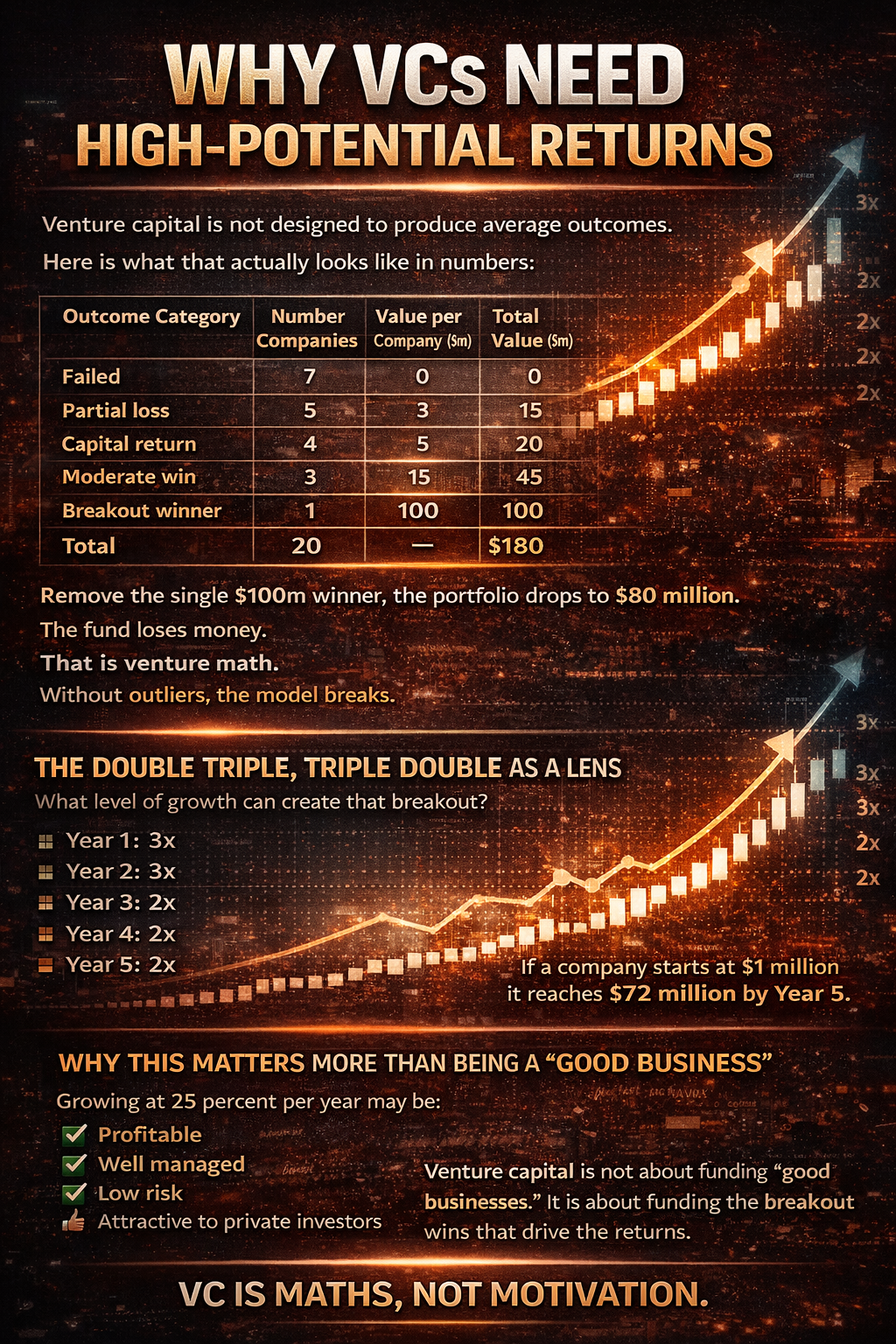
Assume a fund invests $100m across 20 companies, deploying $5m into each.
Five years later, the portfolio looks like this:
|
Outcome Category |
Number of Companies |
Value per Company ($m) |
Total Value ($m) |
|
Failed |
7 |
0 |
0 |
|
Partial loss |
5 |
3 |
15 |
|
Capital return |
4 |
5 |
20 |
|
Moderate win |
3 |
15 |
45 |
|
Breakout winner |
1 |
100 |
100 |
|
Total |
20 |
— |
180 |
Total invested: $100m
Total value after 5 years: $180m
Gross multiple: 1.8x
Now remove the single $100m winner.
The portfolio drops to $80m.
The fund loses money.
That is the reality of venture math.
Without outliers, the model breaks.
The Double Triple, Triple Double as a Lens
So, what kind of company can realistically produce that breakout outcome?
One way to frame the magnitude required is the Double Triple, Triple Double model:
📊 Year 1: 3x
📊 Year 2: 3x
📊 Year 3: 2x
📊 Year 4: 2x
📊 Year 5: 2x
If a company starts at $1 million in revenue and executes this path, it reaches $72 million by Year 5.
That level of structured compounding creates:
💰 Major valuation step-ups
🏦 Access to later-stage capital
🤝 Exit optionality
🔥 The potential for 10x to 30x equity outcomes
It is not about one lucky year.
It is about sustained hypergrowth with operational discipline that can carry a fund.
Why This Matters More Than Being a “Good Business”
Here is the uncomfortable truth.
A business growing at 25 percent per year may be:
✅ Profitable
🧠 Well managed
🛡️ Low risk
👍 Attractive to private investors
But it is often not venture-backable.
Not because it lacks quality.
Because it cannot mathematically return the fund.
If you cannot demonstrate:
🌍 A market large enough to support extreme scale
⚙️ A model capable of repeated high-multiple growth
📈 Evidence of early compounding
🏗️ Operational capacity to sustain it
Then a VC fund may simply conclude:
“This cannot produce a fund-returning outcome.”
That does not make the business flawed.
It makes it mispriced for venture capital.
The Bigger Point
VC is not about funding good businesses.
It is about funding businesses capable of absorbing portfolio losses and still delivering outsized returns.
The Double Triple, Triple Double is one practical way to pressure-test whether that potential exists.
If you cannot credibly map a path to that level of compounding, venture capital may not be the right capital.
That is not a rejection of ambition.
It is alignment with the mathematics of the asset class.
Final thought
VC is maths, not motivation.
If you think your business is venture-backable, show the compounding.
If you want help working that out, let’s talk.
Wayne Wanders is an experienced Business Advisor and Outsourced CFO who can help to scale and grow your business profitably.
Contact Wayne on wayne@arealcfo.com.au or 0412 227 052.
Click on the below buttons to access other free Resources developed by Wayne Wanders, A Real CFO to help your business scale and grow profitably
Want a confidential discussion on your business situation, help with your grant application or to learn more about my Outsourced CFO Services, simply email me at wayne@aRealCFO.com.au or call me on 0412 227 052
