

Controlling the Controllables
A Practical Guide to Business Survival and Growth
Most businesses don’t fail instantly.
They fail from delayed decisions.
A practical guide to regain clarity, act earlier, and stay in control when it matters most.
👉 Or message me and I’ll send the full guide directly email: Wayne@aRealCFO.com.au Phone: 0412 227 052
Introduction
Most businesses don’t fail from lack of effort.
They don’t fail from lack of ideas.
They fail because decisions are made too late, without clarity, under pressure.
The current environment is not defined by a single event.
It is constant pressure.
Rising costs
Tighter margins
Uncertainty around demand
More decisions, more often, with less certainty
This is where most businesses struggle.
Not because they don’t care.
But because they are operating without clear visibility of what is coming next.
The Controlling the Controllables guide is built from working alongside business owners in exactly these conditions.
It is not theory.
It is a practical guide to help you:
- Get clarity on where your business actually stands
- Make better decisions earlier
- Stay in control when it matters most
At its core is a simple principle:
Control the controllables.
What This Means in Practice
Cannot control:
- The economy
- Interest rates
- Customer sentiment
- Competitor behaviour
Can control:
- Your visibility
- Your decisions
- Your timing
- Your response
Most businesses don’t fail from lack of effort.
They fail from delayed decisions.
What This Looks Like in Practice
The Controlling the Controllables guide focuses on the areas that consistently determine whether a business stays in control or drifts.
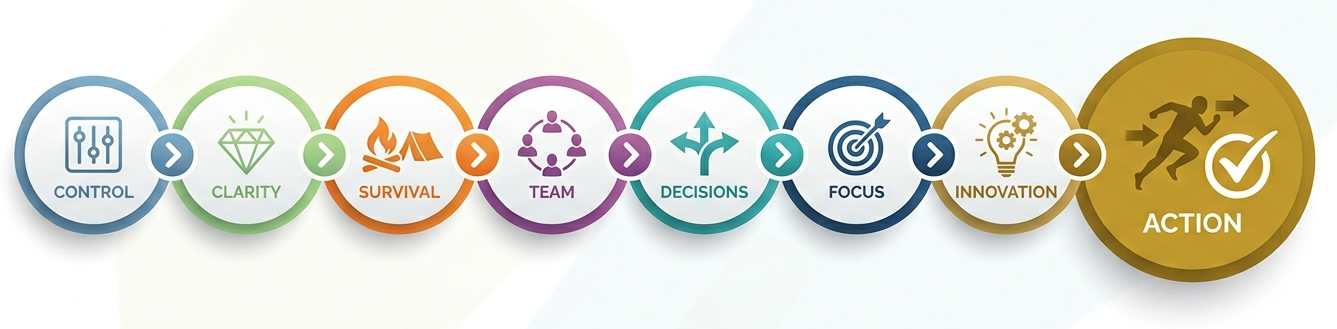

1. Control
Most businesses don’t lose control suddenly.
They drift.
Small issues build.
Decisions get delayed.
Visibility reduces.
Control starts with understanding where the pressure actually is.
If you cannot clearly see your current position, you are already reacting.

2. Clarity
Clarity comes from numbers that are actually useful.
Not reports for compliance.
Not historical data.
Forward visibility.
Cash flow forecasting is one of the simplest ways to create this.
It allows you to:
- See pressure before it hits
- Make decisions earlier
- Avoid reactive moves
If you do not currently have this level of visibility, this is one of the fastest ways to regain control.

3. Survival
When conditions tighten, long-term planning becomes less relevant.
Short-term discipline matters more.
The businesses that get through difficult periods stay close to the numbers.
Weekly, not monthly.
They focus on:
- What needs to be paid
- What needs to be addressed
- What actions need to happen now
If you cannot clearly see the next 4 to 8 weeks, this is where to focus first.

4. Your Team
Your team is not just a cost line.
How you treat your team during pressure determines what happens next.
Short-term decisions can reduce cost.
But they can also destroy trust and capability.
The businesses that recover fastest are the ones that manage both.

5. Decisions
Most businesses don’t struggle with what to do.
They struggle with when to act.
That delay is where problems grow.
Decision triggers change this.
They define in advance:
“If this happens, we act.”
This removes hesitation and ensures action happens early.
If your decisions feel reactive, this is often the gap.

6. Focus
When things get harder, many businesses try to do more.
That usually creates noise.
Clarity comes from focus.
A simple way to reset:
- Stop what is not working
- Start what matters
- Keep what delivers
If everything feels important, nothing is.

7. Innovation
Real improvement does not start in the boardroom.
It starts with the people closest to the work.
The ones who:
- See inefficiencies
- Experience friction
- Hear customer issues
The role of leadership is to surface, prioritise, and act on those insights.

8. Action
Most businesses know what needs to be done.
They just act too late.
The difference is timing.
See earlier
Decide earlier
Act earlier
That is what changes outcomes.
Where Most Businesses Get Stuck
Understanding the framework is one thing.
Seeing how it applies to your business is another.
Most businesses:
- Know something is off
- Feel the pressure building
- But cannot clearly see where the problem actually is
So they:
- Delay decisions
- Focus on the wrong areas
- Or react too late
That gap is where performance slips.
The Bottom Line
You cannot control everything.
But you can control how you respond.
The businesses that perform best in uncertain conditions are not the ones with perfect information.
They are the ones who:
- create clarity
- make decisions earlier
- act with discipline
That is what it means to control the controllables.
Get the Full Guide Below
If you can see parts of this happening in your business, the next step is getting clear on where you actually stand.
This guide gives you a practical way to do that.
Inside, you’ll find:
- real examples
- simple frameworks you can apply immediately
- practical actions across each part of the model
Run a Business Diagnostic
Take It One Step Further and see where your business stands
Reading the framework is one thing.
Applying it to your business is where the value sits.
A short structured diagnostic will help you identify:
- where your biggest risks are
- where decisions are being delayed
- what matters most right now
In 15–20 minutes, we will work through the key areas together.
Most sessions surface one or two issues that are driving the majority of pressure.
👉 Email or call me to run the diagnostic email: Wayne@aRealCFO.com.au Phone: 0412 227 052
About
Wayne Wanders works alongside business owners to help them make better decisions and implement them effectively.
Not just advice.
Clarity, structure, and execution.
Click on the below buttons to access other free Resources developed by Wayne Wanders, A Real CFO to help your business scale and grow profitably
And Wayne is always posting about new grants, funding options and other resources on LinkedIn that can help your business scale and grow profitably. Click on the below links and connect with Wayne or follow A Real CFO on LinkedIn.
Want a confidential discussion on your business situation, simply email or call me.
