

Should You Give a Technical Co-Founder 30% Equity Upfront?
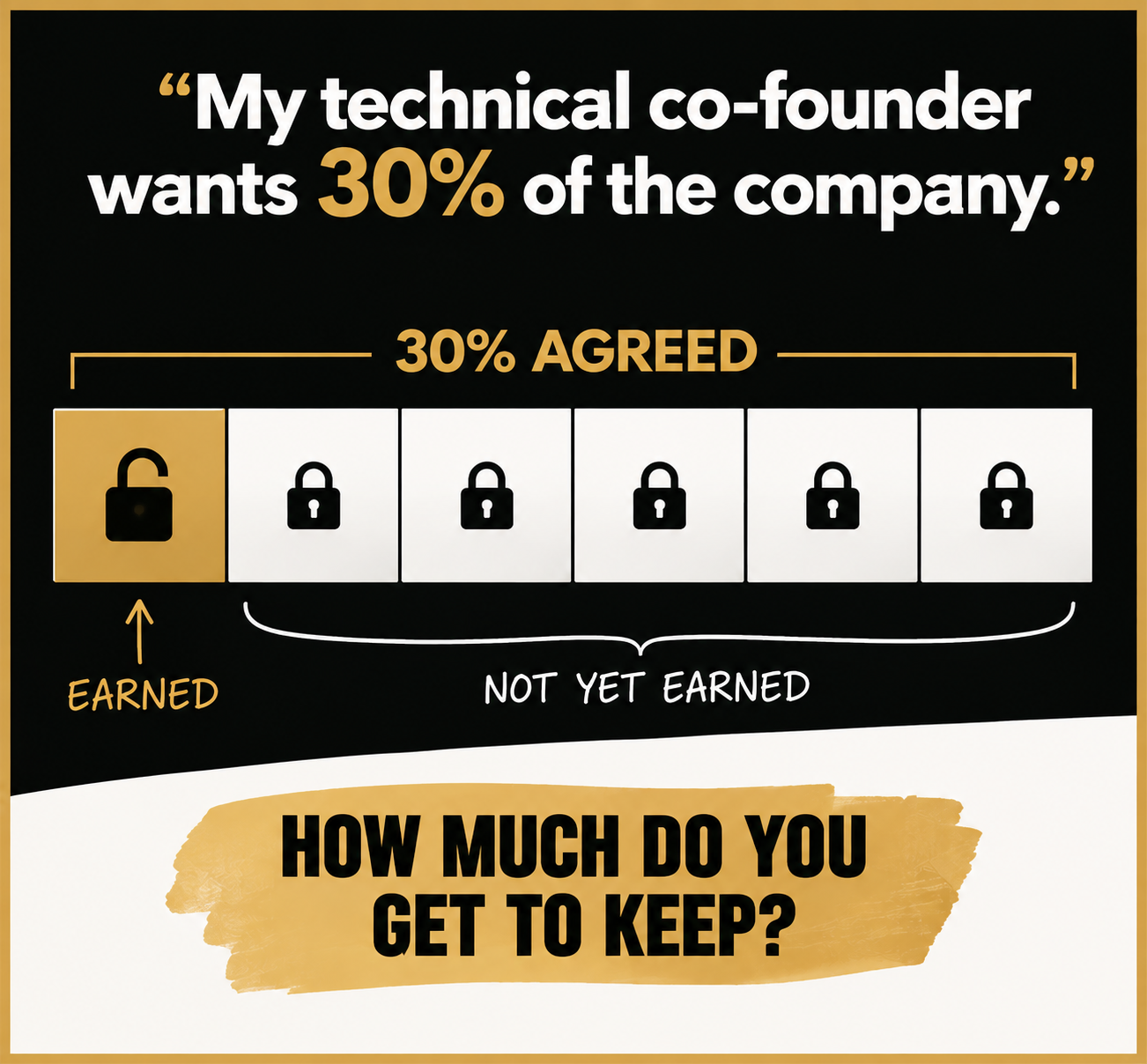
“My technical co-founder wants 30% of the company.”
It’s a question I’ve heard in different forms from many startup founders.
They have the idea, they’ve done the customer research, and they’ve started building the business structure. Now they need someone technical to build the product.
They find someone, and the conversation quickly becomes:
💬 “I’ll build it for 30% of the company.”
Before agreeing to the percentage, there is a critical question every founder needs to ask:
🤔 What happens if they don’t build it?
The Risk of Upfront Startup Equity
If their market salary is $200,000 and they work for a year for nothing, 30% equity is a significant—and potentially fair—contribution. They are putting their career on hold and taking genuine risk to build the product full-time.
Perhaps 30% turns out to be entirely reasonable.
But what if they work nights for three months, produce half an MVP, and then disappear?
❓ Should they still own 30% of your company?
That’s the core issue with giving away co-founder equity upfront for work that is supposed to happen in the future: you are paying today for something that hasn’t been delivered yet.
Protect Your Business with Reverse Vesting
To protect your startup’s future, consider using a reverse vesting schedule.
Under a reverse vesting agreement, the co-founder receives their shares upfront, but they don’t have an unconditional right to keep all of them from day one. Instead, the shares vest over time or as agreed technical milestones are achieved.
If they leave early, any unvested shares can be bought back by the company or transferred under the agreement.
So perhaps the conversation shouldn’t be: “Is 30% too much equity?”
Instead, ask: “What needs to happen for you to earn the right to keep that 30%?”
Defining Co-Founder Vesting Milestones
A structured vesting arrangement typically ties equity retention to key deliverables, such as:
- 💻 Building the MVP to agreed specifications.
- 🚀 Getting the product commercially ready for launch.
- ⏱ Working full-time in the business.
- 🎯 Reaching agreed technical milestones.
- 📅 Remaining with the business for an agreed period (e.g., a standard 4-year vesting schedule with a 1-year cliff).
The Bottom Line
- Deliver everything and stay? ✅ You ultimately keep the full 30%.
- Leave after six months with half the product built? ❌ You don’t walk away with 30% of the company.
Note: The legal and tax structures around share vesting, buybacks, and Section 83(b) or local tax implications must be properly worked through with your professional advisors before signing.
The issue isn’t necessarily how much equity you agree to give a technical co-founder. It’s ensuring they don’t get to keep all of it before they’ve actually delivered what that equity was meant to recognize.
📌Frequently Asked Questions:
Q: What is the difference between time-based and milestone-based vesting?
A. Time-based vesting releases equity solely based on duration—for example, monthly over four years. Milestone-based vesting releases equity only when specific, pre-agreed goals are hit, such as completing an MVP, reaching commercial launch, or securing seed funding. Many startups use a hybrid model, requiring both a minimum time commitment and specific technical deliverables to unlock equity chunks.
Q: What is a typical vesting schedule for a technical co-founder?
A: A standard time-based schedule spans 4 years with a 1-year cliff (25% vests at month 12, then monthly for the remaining 3 years). However, when founders want protection against incomplete work, they often add milestone triggers—such as vesting the first 10% upon MVP delivery, regardless of time, with the remainder following a standard monthly schedule.
Q: What is the difference between vesting and reverse vesting?
A: With traditional vesting, shares are issued gradually over time or as milestones are met. With reverse vesting, the co-founder receives all their shares upfront on day one (giving them immediate voting or shareholder rights), but the company holds an option to buy back any unvested shares if the co-founder leaves early or fails to hit agreed milestones.
.
Q: How do you set clear milestones for a technical co-founder’s equity?
A: Milestones must be objective and measurable to prevent disputes. Common technical milestones include:
- Product: Delivery of a functional, tested Beta/MVP to spec.
- Commercial: Achieving commercial launch or first paying customer.
- Operational: Maintaining 99.9% uptime or completing key IP assignments.
If a milestone isn’t hit, the equity associated with that milestone remains unvested and subject to company buyback.
Q: How much equity should a non-technical founder give a technical co-founder?
A: Equity split depends on timing, risk, and contribution. If a technical co-founder joins at the ideation stage for zero salary and builds the core product, splits often range from 30% to 50%. If product specification, initial funding, and go-to-market groundwork are already established, equity typically sits between 15% and 30%, almost always tied to a vesting or milestone schedule.
returned to the company treasury or shared pool.
Wayne Wanders is an experienced Business Advisor and Outsourced CFO who can help to scale and grow your business profitably.
Contact Wayne on wayne@arealcfo.com.au or 0412 227 052.
Click on the below buttons to access free Resources developed by Wayne Wanders, A Real CFO to help your business scale and grow profitably
And Wayne is always posting about new grants, funding options and other resources on LinkedIn that can help your business scale and grow profitably. Click on the below links and connect with Wayne or follow A Real CFO on LinkedIn.
Want a confidential discussion on your business situation, help with your grant application or to learn more about my Outsourced CFO Services, simply email me at wayne@aRealCFO.com.au or call me on 0412 227 052

Trackbacks/Pingbacks