

How to Calculate How Much Equity Your Co-Founder Has Actually Earned
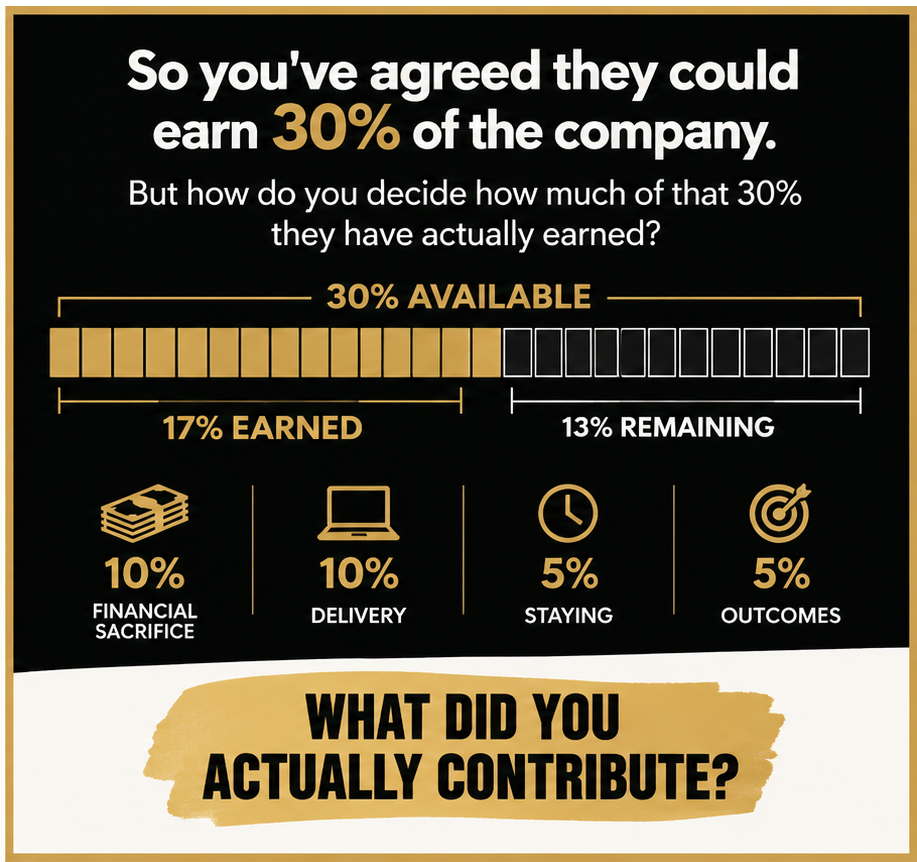
So you’ve agreed your technical co-founder could earn 30% of the company.
In my recent post, we looked at reverse vesting, the idea that a co-founder receives shares upfront, but their right to keep all of them depends on staying and delivering what was agreed.
Reverse vesting solves one major problem. But it creates another:
🤔 How do you calculate how much of that 30% equity should actually vest?
Tracking Co-Founder Contributions: The Equity Scoreboard
I’ve been reading Mike Moyer’s Slicing Pie, which looks at founder equity through the lens of actual contributions made to a startup.
It got me thinking about a tracking system I call “Grunt Nuggets.” Think of them as a way of keeping score.
When building an early-stage business, a co-founder might contribute:
- 💰 Cash invested directly.
- ⏱️ Unpaid time spent building and executing.
- 💵 Forgone salary—the market rate they could have earned elsewhere.
- 💻 Product development and technical execution.
- 📈 Business milestones delivered on schedule.
- 💳 Business expenses paid out of their own pocket.
Each item represents genuine value contributed or risk taken.
So instead of saying:
“You get 30% because we arbitrarily agreed on 30% on day one,”
you agree that 30% is the maximum equity opportunity.
Then, you track contributions made along the way to determine how much of that equity actually reverse vests.
Structuring Milestone-Based Equity Allocations
To turn this into a clear framework, you might break down that 30% allocation into specific contribution categories:
- 💵 10% for Financial Sacrifice: Working full-time for substantially below market salary.
- 💻 10% for Product Delivery: Building the MVP, getting it production-ready, and launching it.
- ⏱ 5% for Time & Commitment: Continuing to contribute to the business over an agreed timeline.
- 🎯 5% for Technical Outcomes: Achieving agreed product or performance milestones.
What Happens When a Co-Founder Leaves Early?
Imagine your technical co-founder leaves after 18 months.
Without an agreed tracking model, you end up in an emotional dispute:
“You didn’t do enough” vs. “I worked incredibly hard.”
With a contribution scoreboard, you evaluate objective data:
❓ What did they contribute?
❓ What did they deliver?
❓ What did they put at risk?
❓ What had actually vested under the agreement?
✅ Perhaps they earned 17%.
They keep 17%. The remaining 13% unvested portion is dealt with under your reverse-vesting agreement (typically bought back by the company at nominal value).
The exact percentages and metrics will differ for every startup. But the underlying framework remains constant:
🔒 Reverse vesting provides the legal mechanism.
📊 Grunt Nuggets provide the objective scoreboard.
If equity is given for future contribution, having a clear way to measure whether that contribution actually happened protects both the founder and the business.
📌Frequently Asked Questions:
Q: What is the Slicing Pie model for co-founder equity?
A. The Slicing Pie model (created by Mike Moyer) is a dynamic equity split system. Instead of fixing equity percentages upfront, equity is allocated based on the relative value of real-time inputs—such as cash invested, unmarket-paid time, IP, and facilities—until the company achieves revenue or raises capital.
Q: How do you calculate forgone salary for startup equity?
A: Forgone salary (or “opportunity cost”) is calculated by subtracting any cash compensation paid by the startup from the co-founder’s fair market salary. For example, if a developer’s market salary is $180,000 and they work full-time for $30,000, they are contributing $150,000 per year in uncompensated salary risk.
Q: Can you combine time-based vesting with contribution tracking?
A: Yes. Many startups use hybrid reverse vesting, where a portion of equity vests automatically over time (e.g., 4-year time schedule) while the remaining equity is unlocked only when specific technical or financial milestones are delivered.
.
Q: What happens if a co-founder disputes their contribution score?
A: To avoid disputes, contribution tracking metrics (like MVP specs, working hours, and expense logs) must be agreed upon in writing beforehand and reviewed quarterly. If a co-founder leaves, the reverse vesting agreement uses these documented logs to determine final vested equity.
Wayne Wanders is an experienced Business Advisor and Outsourced CFO who can help to scale and grow your business profitably.
Contact Wayne on wayne@arealcfo.com.au or 0412 227 052.
Click on the below buttons to access free Resources developed by Wayne Wanders, A Real CFO to help your business scale and grow profitably
And Wayne is always posting about new grants, funding options and other resources on LinkedIn that can help your business scale and grow profitably. Click on the below links and connect with Wayne or follow A Real CFO on LinkedIn.
Want a confidential discussion on your business situation, help with your grant application or to learn more about my Outsourced CFO Services, simply email me at wayne@aRealCFO.com.au or call me on 0412 227 052
