

The First July 2026 Payroll: 2 Hidden Risks to Your Cash Flow
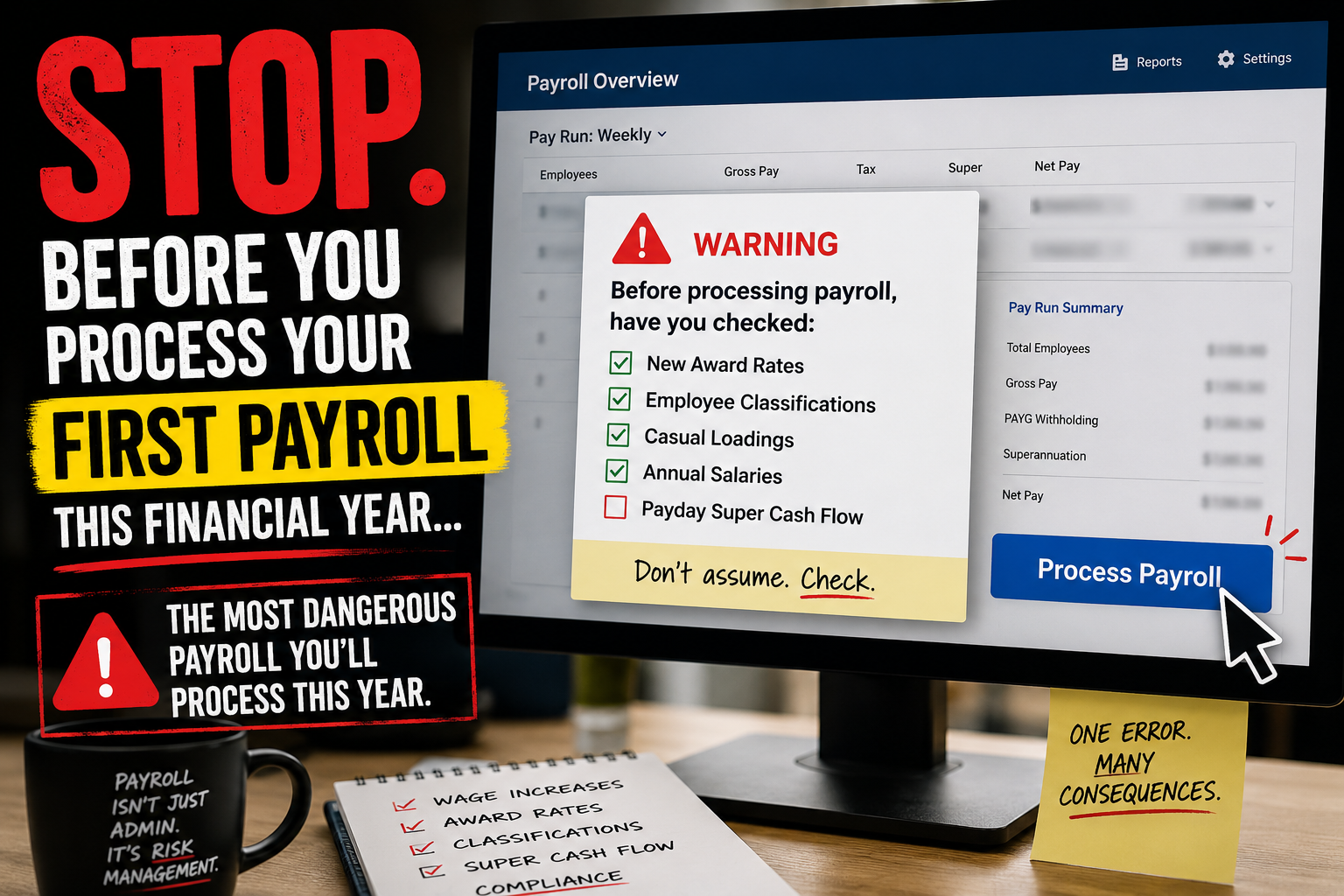
⚠️ The First Payroll You Process Could Be the Most Dangerous Payroll You’ll Run All Year.
Why?
The first payroll of the 2027 financial year is where two significant changes collide.
⚖️ One could expose your business to an underpayment claim.
💰 The other could quietly squeeze your cash flow.
📈 Mistake #1 – Thinking It’s Just a Wage Increase
Every July I hear the same question.
“What’s the wage increase this year?
It’s the wrong question.
The better question is:
“What do I need to change in my payroll?”
The Fair Work Commission’s Annual Wage Review isn’t simply about applying one percentage increase across your workforce.
This year’s decision includes structural adjustments to some award classifications, meaning not every employee’s minimum pay rate changes in the same way.
If you simply apply a blanket increase, you could still end up underpaying employees.
That’s particularly risky if you employ staff under modern awards, pay annual salaries, or rely on above-award rates.
Before processing your first payroll, ask yourself:
✔ Have all employees been correctly classified?
✔ Has your payroll software been updated with the new award rates?
✔ Are casual rates, penalties and allowances correct?
✔ Do your annual salary arrangements still satisfy award obligations?
✔ Are employees paid above award still genuinely above the new minimum requirements?
🚨 Remember…
An honest mistake is still an underpayment.
💸 Mistake #2 – Treating Payday Super as “Someone Else’s Problem”
Most of the discussion around Payday Super has focused on compliance.
I think that’s missing the real issue.
💵 Cash flow
As businesses transition to paying super with every payroll, money that once stayed in your bank account until the quarterly due date will begin leaving much sooner.
For some businesses, that won’t be a problem.
For others, it will expose cash flow weaknesses and raise the question, will you have the cash available every payday to pay it.
🛑 Don’t Treat This Payroll as “Business as Usual”
Before you click Process Payroll, stop and ask yourself:
✔ Are employee classifications correct?
✔ Have the new award rates been applied?
✔ Are casual loadings, penalties and allowances accurate?
✔ Do annual salary arrangements still pass the compliance test?
✔ Have you considered the impact of more frequent super payments on your cash flow?
Payroll isn’t just about paying your employees.
It’s one of the biggest compliance and cash flow risks your business manages.
Get this payroll right and you’ll probably never think about it again.
Get it wrong and you could be dealing with underpayments, back pay, penalties or cash flow pressure for months to come.
That’s why the first payroll you process this financial year could be the most dangerous payroll you’ll run all year.
📌 Frequently Asked Questions: The July 2026 Payroll Collision
Q: What are the exact minimum wage changes that take effect today?
The Fair Work Commission’s decision splits the increase into two buckets, starting from your first full pay period on or after 1 July 2026:
- Modern Award Minimums: Increased by 4.75%.
- National Minimum Wage (Award-Free): Increased by 6% (bringing the new minimum to $1,004.90 per week or $26.44 per hour).
Q: Why did you say a "blanket percentage increase" could cause an underpayment claim?
Because this year, Fair Work didn’t just change the percentage; they changed the structure. They have officially started a multi-stage phase-out of the lowest award classifications (specifically the C13 level). If you have employees on these lower tiers, their mandatory adjustment is higher than the standard 4.75% headline rate. Applying a flat percentage across your entire payroll without checking individual classification structural updates is a major compliance trap.
Q: What is the exact deadline for clearing Payday Super?
Superannuation guarantee contributions must now be received and accepted by your employees’ super funds within 7 business days of their payday.
It is no longer anchored to a quarterly deadline. The rule applies strictly to the actual day you pay the wages, not the period the work was performed.
Q: Why is Payday Super considered a cash flow issue rather than just a compliance chore?
Under the old quarterly rules, businesses could hold onto their cash for up to 90 days, utilizing that liquidity to manage operational expenses before making a lump-sum payment to the ATO/funds.
Now, that money leaves your account within days of every single pay run. If you pay weekly or fortnightly, your cash outflow frequencies accelerate dramatically. Without a strict 13-week cash flow forecast mapping these frequent drops, a business can easily find its bank account short on a standard payday.
Q: Does Payday Super apply to contractors?
Yes. If an independent contractor is considered an “employee for superannuation purposes” (meaning they are paid wholly or principally for their personal labor), their superannuation contributions must be paid and cleared within the same 7-business-day timeframe as regular staff.
Wayne Wanders is an experienced Business Advisor and Outsourced CFO who can help to scale and grow your business profitably.
Contact Wayne on wayne@arealcfo.com.au or 0412 227 052.
Click on the below buttons to access free Resources developed by Wayne Wanders, A Real CFO to help your business scale and grow profitably
And Wayne is always posting about new grants, funding options and other resources on LinkedIn that can help your business scale and grow profitably. Click on the below links and connect with Wayne or follow A Real CFO on LinkedIn.
Want a confidential discussion on your business situation, help with your grant application or to learn more about my Outsourced CFO Services, simply email me at wayne@aRealCFO.com.au or call me on 0412 227 052
